
Quick answer
A ccTLD such as .co.uk or .de tells Google a site is for one country; a gTLD such as .com has no country of its own, so Google relies on content, address, language, links and hreflang. For one country, either works. For several countries run by one team, one .com with a subfolder per market (example.com/de/) is usually simplest to build and maintain. Separate ccTLDs suit large brands with a team per market. Avoid URL parameters.
Key takeaways
- A ccTLD (.co.uk, .de, .com.au) is a strong signal that a site is for one country; a gTLD (.com) is not tied to any country.
- Some country codes, such as .io, .ai and .co, are treated by Google as generic.
- Search Console country targeting is no longer supported; the country signal comes from content, links, business details and hreflang.
- Subfolders on one .com are the easiest structure for most multi-country businesses to run.
- Country-code domains come with registry rules that can rule them out without a local entity.
- Changing structure later is a full site move, so choose once and redirect the extra domains.
When a business starts selling in more than one country, the website has to answer a structural question: one country-code domain per market (example.co.uk, example.com.au, example.de), one .com with a subdomain per market (uk.example.com), or one .com with a subfolder per market (example.com/uk/)? It sounds like a naming choice. In practice it decides how Google works out which country each page is for, how much each new market costs to run, and how painful it will be to change your mind.
This guide explains the difference between a ccTLD and a gTLD, how Google uses each, and how to choose a structure that fits where your customers are. It is the first decision we make in our multi-country SEO work.
What is a ccTLD, and how is it different from a gTLD?
The top-level domain is the last part of a web address. There are two kinds that matter here:
- Country-code top-level domains (ccTLDs) belong to a country or territory: .uk, .au, .de, .in, .np and so on. Many countries also use second-level versions, such as .co.uk or .com.au.
- Generic top-level domains (gTLDs) such as .com, .org and .net are not tied to any country. Google says regional domains such as .eu and .asia are generally treated like gTLDs too.
Google’s guide to multi-regional and multilingual sites calls a ccTLD a strong signal to users and search engines that a site is meant for one country. A .com carries no country signal of its own.
One trap catches many startups: some country codes are treated as generic because they are mostly used that way. Google lists examples including .ai, .io, .co, .me and .tv, and says the list can change. A .io or .ai domain does not tie your site to any one country in Google’s eyes; for geotargeting it behaves like a .com.
How does Google decide which country a site is for?
Google’s multi-regional guide lists the signals it uses to work out which country a site or page targets:
- The ccTLD, where there is one.
- hreflang annotations that link language or country versions of the same page.
- Server location, which Google says is not a definitive signal, since many sites sit behind content delivery networks.
- Other signals on and around the page: local addresses and phone numbers, local language and currency, links from local sites, and Google Business Profile data.
Two older habits no longer help. Search Console’s International Targeting report has been deprecated, and Google says country targeting through Search Console is no longer supported. Google also says it ignores geo.position and similar geo meta tags. On a .com, the country signal for each section now comes from its content, business details, links and hreflang.
Google also warns against redirecting visitors automatically by IP address or browser language, because people and Googlebot may never reach the other versions. Googlebot mostly crawls from the US and does not send an Accept-Language header. Offer a visible country or language switcher instead.
ccTLD vs subdomain vs subfolder: the trade-offs
Google sets out the same four options most international sites choose between:
- A country-code domain per market (example.de). Clearest geotargeting, server location does not matter, and each site is easy to separate. The cost: more domains to buy and run, possible limited availability, sometimes strict registry rules, and each domain serves only one country.
- Subdomains on a gTLD (de.example.com). Easy to set up and can sit on different servers. Google notes that visitors cannot always tell from the URL whether “de” means a language or a country.
- Subfolders on a gTLD (example.com/de/). Easy to set up and low maintenance, because everything stays on one host. The country is less obvious from the URL, and the sections are harder to split apart later.
- URL parameters (example.com?loc=de). Google marks this option as not recommended.
Google does not say any one of these ranks better. The differences are in how clearly each tells people and search engines which country a page serves, and in how much work each market adds.
ccTLD vs subdomain vs subfolder vs URL parameter
| Set-up | Best for | Strength | Trade-off |
|---|---|---|---|
| ccTLD per country (example.de) | Large brands with a team per market | Clearest country signal; server location does not matter | Each domain built and run separately; registry rules vary |
| Subdomain (de.example.com) | Markets that need separate hosting | Easy to set up; can sit on different servers | Visitors may not tell if de means a language or a country |
| Subfolder (example.com/de/) | Most businesses entering several markets | One site to maintain; easy to set up | Country less obvious from the URL; harder to split later |
| URL parameter (?loc=de) | Nobody | None worth having | Google marks it as not recommended |
Which structure should you choose?
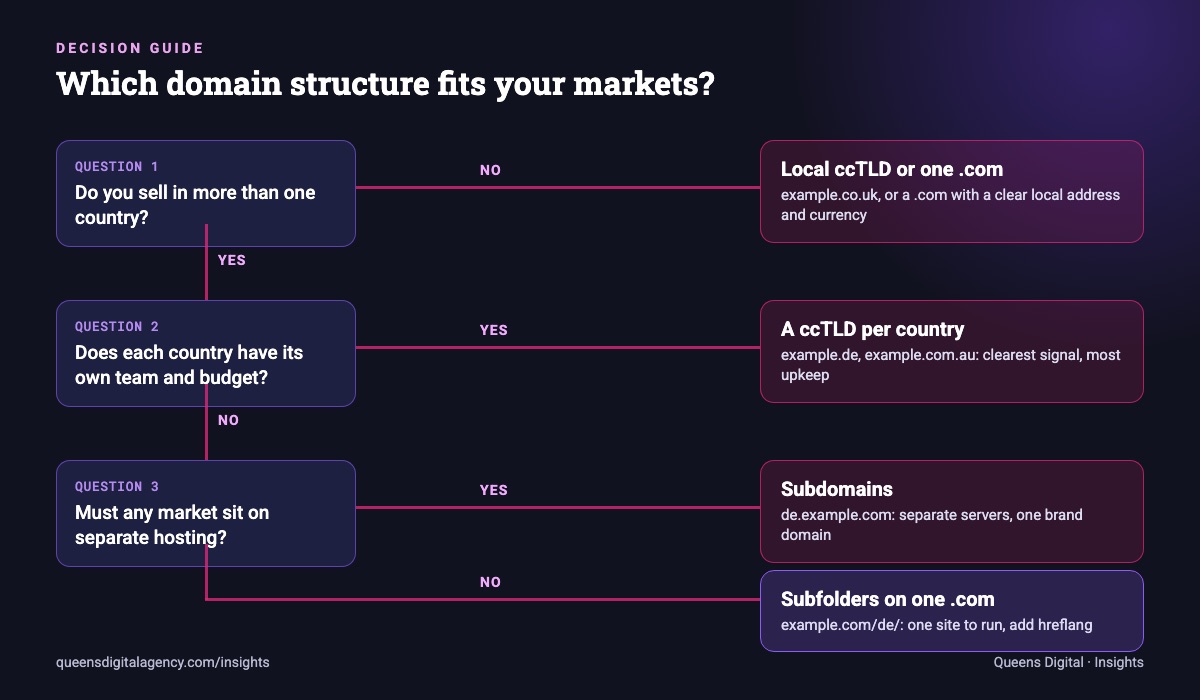
Start with where your customers are and how much you can maintain, not with which name sounds better. In our practice, four situations cover most businesses:
- One country only. Use the local ccTLD (example.co.uk for a UK-only firm) or a .com with a clear local address, phone number and currency. Either works; the ccTLD makes the country obvious at a glance.
- One main market now, more later. Use a .com, so you can add markets without starting new domains.
- Several countries or languages, one team. Use one .com with a subfolder per market, such as /uk/, /de/ and /fr/. You maintain one site, and each new market is a new section rather than a new website.
- Large brands with a local team per country. Separate ccTLDs can make sense when each country has its own content, links and people to run them.
When the same content exists for more than one country or language, connect the versions with hreflang and give each a self-referencing canonical. Our step-by-step hreflang guide covers the codes, return links and common mistakes, so we will not repeat it here.
Language versions are about more than the URL. Our work with Sanforce Technology, an emergency-lighting manufacturer selling to around 30 countries, grew from an English-only site into Russian, Arabic, Vietnamese and German versions, with content written for each market rather than simply translated.
Country-code domains come with registry rules
Google lists “sometimes strict” ccTLD requirements as a drawback, and it is worth checking them before you plan a market around one. Each country’s registry sets its own rules on who may register and which names are allowed.
Nepal’s .np registry is one example of how different these can be from buying a .com. Its registry policy says registration is free, but foreign companies must have an official presence in Nepal, such as a joint venture, partnership, agent or licensee, and prove it with documents. Its registration instructions add that a company may only register a name based on its company, product, service or brand name.
Rules like these can make a country-code domain impossible, or slow, for a business with no local entity. A subfolder on your .com has no such hurdle.
Switching structures later, and owning several domains
Our working rule: register the names you need to protect your brand, choose one structure for the real site, and 301 redirect the rest to it. Never run full copies of the same site on several domains; you end up with weaker sites competing with each other.
Moving from country domains to subfolders, or the reverse, is a site move. Google’s site move guide asks for a URL-by-URL redirect map, permanent server-side redirects, the Change of Address tool in Search Console for domain moves, and redirects kept in place for generally at least a year. It also warns that rankings will fluctuate for a while. Our checklist for moving a site without losing traffic turns that into steps, and the redirect, canonical and template work usually runs through our technical SEO team.
Planning a move into a new market? Queens Digital, a Nepal-based SEO and AI/GEO agency working with clients abroad, can review your current structure and tell you, in plain language, which set-up fits your plans. Ask us for a free SEO review.
Explore More
Reviewed by
K.K. Bhatta
K.K. Bhatta is a general digital marketer at Queens Digital Agency: hands-on across SEO, paid media, and whatever platform changes next. A lifelong learner rather than a one-topic specialist, he tests ideas on live campaigns before writing about them, and stays skeptical of anything that has not actually been tried.
Every claim in this article was checked against a live source before publishing.
A ccTLD is a country-code domain such as .uk, .de or .com.au, which Google treats as a strong signal that a site is for that country. A gTLD such as .com, .org or .net has no country of its own.
Google does not say either ranks better. Subfolders are easier to run because everything stays on one site; subdomains suit markets that need separate hosting. Visitors may not tell from a subdomain whether it means a language or a country.
No. Google lists .io, .ai, .co, .me and .tv among the country codes it treats as generic, so they behave like a .com for geotargeting.
Yes. Google works out a .com site’s country from its content, language, currency, address, phone number, local links and hreflang. A clear local presence on the page does the work a ccTLD would.
No. Most businesses do well with one .com and a subfolder per market. Separate ccTLDs make sense when each country has its own team, content and budget to build the site up.
Sources and references
Facts in this guide come from the sources below, checked live on 8 November 2026. Everything else is our own working practice, stated as such.
- Google Search Central, Managing multi-regional and multilingual sites
- Search Console Help, The International Targeting report is deprecated
- Google Search Central, Site moves with URL changes
- Google Search Central, Localized versions of your pages (hreflang)
- .np Domain Registry (Mercantile Communications), Registry policy
- .np Domain Registry, How to register a .np domain