
Quick answer
Digital PR means earning coverage and links from news and trade sites by giving journalists something worth publishing: your own data, a timely story or expert commentary. Pitch one reporter at a time, in the language of the publication, with an evidence page they can link to, and reclaim mentions that name you without a link. Paid or sponsored articles are advertising: Google asks for their links to be marked rel="sponsored" or nofollow. No one can guarantee earned coverage.
Key takeaways
- Digital PR earns coverage and links with stories editors want, not with link requests.
- Your own anonymised data is the strongest angle, because only you can publish it.
- Quick, accurate expert commentary gets you called again.
- Paid and sponsored placements are ads: their links need rel=“sponsored” or nofollow.
- Unlinked mentions and links to dead pages are the easiest wins to reclaim.
- No one can promise coverage; the editor makes the final call.
A mention in a newspaper or a respected trade site does two jobs at once. Readers learn your name from a source they already trust, and, when the article links to you, search engines see an independent signal that your site is worth citing. That is digital PR: earning coverage and links because you gave a journalist something worth publishing.
This guide sets out a practical digital PR strategy: finding a story, offering expert commentary, pitching the right publications, and reclaiming the mentions you already have. Queens Digital, a Nepal-based SEO and AI/GEO agency, runs this work as part of its off-page SEO service, alongside backlink audits, local listings and lost-link fixes. If you first want to know which links are worth having at all, read our guide to how earned links differ from link spam.
What is digital PR, and how is it different from link building?
Traditional PR aims for coverage: a story in print, on television or on the radio. Digital PR aims for the same coverage online, and it also tracks whether that coverage names and links to the right page on your site. The work is still public relations. Journalists decide what they publish, and they publish what is useful or interesting to their readers.
Link building is narrower. It asks “which sites could link to this page?” and often ends in outreach for a single link. Digital PR starts from a different question: “what do we know that a reporter would want?” Links follow when the answer is good. When it is not, no amount of emailing will fix it.
For most businesses the difference matters in practice. A bank, a college, a clinic or a software company rarely needs hundreds of links. It needs a handful of credible mentions on sites its customers read, plus a clear trail that shows search engines and AI assistants who it is and what it does.
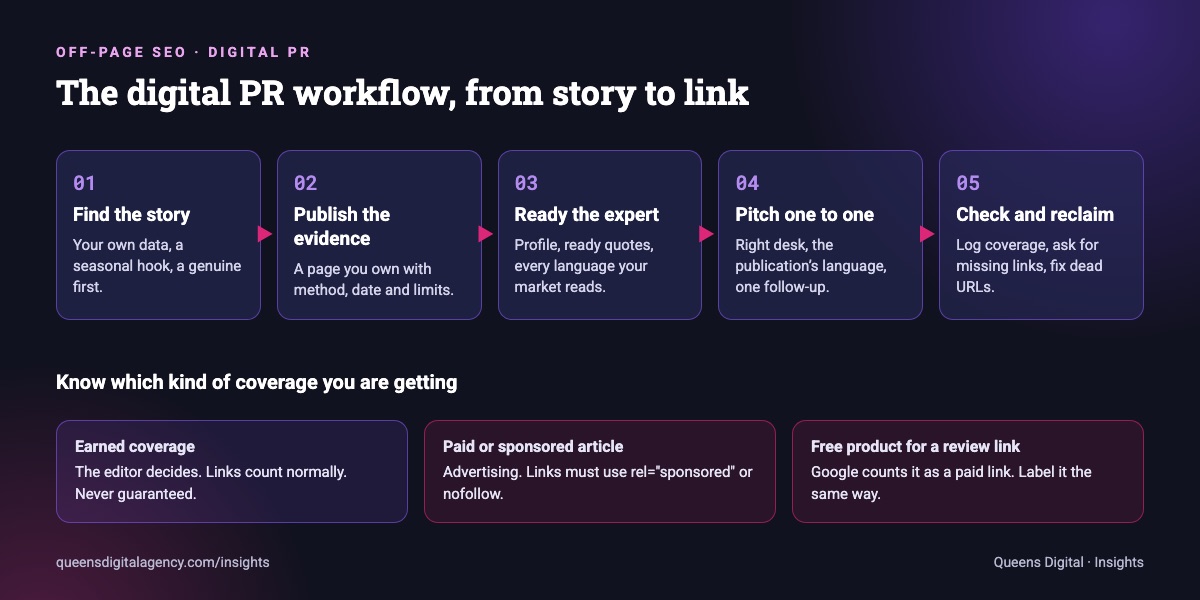
Finding newsworthy data and stories in your own business
Most businesses already hold a story; they just have not shaped it. In our experience, these angles work best:
- Your own data. Anonymised and aggregated figures from your records: which products people ask about most, which months bring the most enquiries, what customers ask before they buy. Data only you hold is the strongest angle, because no one else can publish it first.
- Seasonal and calendar hooks. Budget announcements, exam and admission seasons, holiday shopping, weather seasons and industry events. Editors plan around these dates, so pitch before them, not during.
- Public data with expert context. Government, regulator and central bank publications are full of figures that few people explain. A short, careful explanation of what a new figure means for your sector is useful to reporters on a deadline.
- Genuine firsts and milestones. A new location, a scholarship, a notable partnership, a product that has not been sold in your market before.
- Practical guides. Plain explanations of something people find confusing, such as a new rule or a technical reading. These also make good link targets on your own site.
Before any pitch, put the evidence on a page you own: the method, the sample, the date and the limits of the data. That page is what you want journalists to link to. Our SEO content service builds these pages with sources a reporter can check, because a story that falls apart under questions damages trust instead of building it.
Expert commentary: become the source journalists call
Reporters need quick, quotable views when news breaks: a policy change, a budget line, a price rise, a new technology. A business that can answer within the hour, accurately and in plain language, gets called again.
- Pick one or two spokespeople who really know the subject, and write a short profile for each: role, experience, the topics they can speak on, and a photo.
- Offer every language your market reads. If the publications you want run in more than one language, a spokesperson who can comment in each is far more useful.
- Prepare short quotes in advance on the topics you expect to come up in your sector each year, then adapt them on the day.
- Stay within your expertise. A clinic can comment on a seasonal illness; it should not comment on interest rates. Credibility built on one topic does not transfer to every topic.
- Publish the long version on your own site or professional profiles, so a reporter can see you have thought about the subject before they quote you.
Our Smith Street Medical Centre case study shows this groundwork for a GP group: professional articles on continuity of care, chronic disease management, aged care and mental health coordination, published on its website and on professional platforms.
Commentary often earns a mention without a link. That still has value for brand recognition, and it can be followed up politely, as explained below.
How to pitch journalists without paying for placements
A good pitch is short, personal and specific. Ours follow a simple pattern:
- Choose the right desk and reporter. Read what they have written recently. A business reporter, a health reporter and a technology reporter want different things, even at the same publication.
- Lead with the story in one sentence, then give the two or three facts that support it and a link to the evidence page.
- Write in the language of the publication. Do not send copy in one language and expect the desk to translate it for you.
- Include what makes the story easy to run: a named spokesperson, a phone number, and photos you have the right to share.
- Send it one to one, not as a mass email. Follow up once after a few days, then stop.
The editor makes the final call. No honest agency can promise coverage in a particular publication, and we do not. We can make the pitch useful, accurate and on time.
Paid placements are a separate matter. Google’s link spam policy treats links in advertorials, sponsored articles and press releases distributed on other sites as spam when they pass ranking credit, and it counts a free product given in return for a review that includes a link as a paid link too. Buying an ad or a sponsored article is allowed; Google simply asks for the links to be marked rel=“sponsored” or rel=“nofollow”, with sponsored preferred. If a publication offers to run your “news” for a fee, treat it as advertising and expect the link to be labelled.
Earned coverage vs sponsored content vs press release distribution
| Earned coverage | Sponsored article or advertorial | Press release distribution | |
|---|---|---|---|
| How it is obtained | A journalist chooses to cover your story | You pay the publication | You pay a wire or portal to post it |
| Who decides the content | The editor | You, within the publication’s rules | You |
| How links should be marked | Editor’s choice | rel=“sponsored” or nofollow | Nofollow or sponsored if links pass credit |
| Value for SEO | Highest when relevant and linked | Visibility and traffic, no ranking credit | Little on its own |
| Can it be guaranteed? | No | Yes, it is advertising | Yes, but few people read it |
Reclaiming unlinked brand mentions and lost links
Some of the easiest wins in digital PR are mentions you already have. A newspaper names your company but does not link. A partner links to an old URL that now returns an error. A directory lists your previous phone number.
- Set up alerts. Google Alerts emails you when new results mention a phrase. Create alerts for your brand name, your founder or spokesperson, and your main product names.
- Search every spelling and script. Coverage may spell your name differently, abbreviate it, or write it in another script. A Kathmandu company, for example, may be named in Devanagari in one article and in English in the next. Search each version, including common misspellings.
- Check where your links land. Search Console’s Links report shows your top linked pages, top linking sites and linking text. It is a sample, and it does not show whether a link is nofollow, but it is a good place to spot links pointing at pages that no longer exist.
- Ask politely, once. Thank the writer for the mention and suggest the most useful page for their readers. A link to a relevant guide or evidence page is an easier yes than a link to your homepage.
- Fix the dead ends yourself. If good links point at a removed page, redirect that URL to its closest live replacement. Our redirect checklist for site migrations covers how to map old URLs.
Measuring digital PR honestly
We log every pitch, reply and piece of coverage, and for each one record the publication, the date, whether it names you, whether it links, which page it links to and whether the link is labelled. Over months we track referral visits from coverage, branded searches and the search performance of the linked pages.
What we do not do is claim that one article caused one ranking change. Search results move for many reasons, and digital PR works best when it supports strong pages on a sound site. That is why we plan it together with content and technical work rather than as a stand-alone campaign.
Want a second opinion on your site? Ask us for a free SEO review and we will tell you what to fix first, in plain language.
Explore More
Reviewed by
K.K. Bhatta
K.K. Bhatta is a general digital marketer at Queens Digital Agency: hands-on across SEO, paid media, and whatever platform changes next. A lifelong learner rather than a one-topic specialist, he tests ideas on live campaigns before writing about them, and stays skeptical of anything that has not actually been tried.
Every claim in this article was checked against a live source before publishing.
Digital PR is public relations aimed at online coverage. In SEO terms, it earns mentions and links from news and trade sites because journalists find your story, data or expert view useful to their readers.
No. Link building usually asks sites for a link to a page. Digital PR offers a story or comment first, and links follow when the coverage is published.
No. The editor decides what is published. We can make the story, evidence and pitch strong, but we never promise placements.
Not through links. Google treats paid or sponsored links that pass ranking credit as link spam, so they should be marked rel="sponsored" or nofollow. They can still bring visibility and visits.
Set up Google Alerts for your brand and spokesperson names, search every spelling and script of your name, and ask the publisher politely to add a link to the most relevant page.
Sources and references
Facts in this guide come from the sources below, checked live on 8 November 2026. Everything else is our own working practice, stated as such.