
Quick answer
Google’s August 2026 spam update started on 18 August and finished on 21 August 2026. It applied globally and to all languages, and it enforced Google’s existing spam policies rather than new ones. Google did not say it targeted AI-written content. Its rules judge why and how content is produced, not which tool wrote it: the scaled content abuse policy covers many pages made mainly to manipulate rankings, whether written by AI, people or templates. Useful, accurate, expert-checked AI-assisted content is not the problem.
Key takeaways
- The update ran from 18 to 21 August 2026 and enforced existing rules. No new policies were announced.
- Google did not say it targeted AI content. Its policies target intent and value, not the writing tool.
- Since May 2026, trying to manipulate Google’s AI answers officially counts as spam.
- Compare Search Console data from after 21 August with a clean baseline before 18 August, and rule out other causes.
- If pages lost visibility, improve, merge or remove them. Do not mass-delete everything AI helped write.
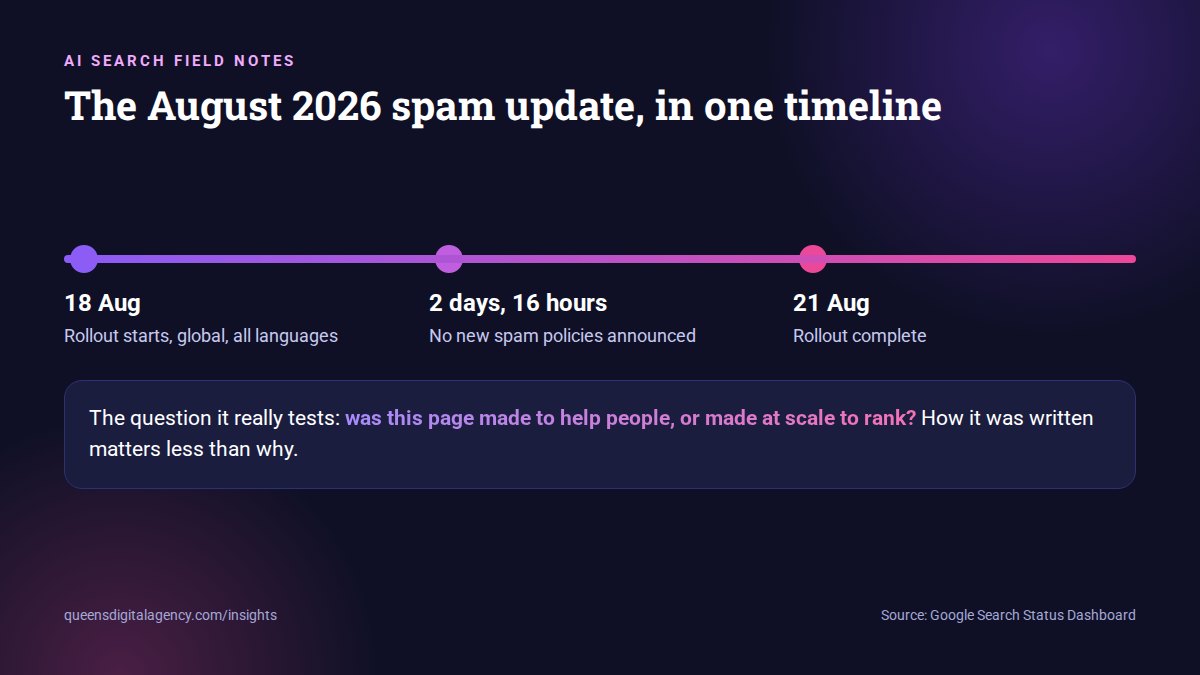
On 18 August 2026, Google posted a short note on its Search Status Dashboard. That was almost the entire announcement.
Released the August 2026 spam update, which applies globally and to all languages. The rollout may take a few days to complete.
 Google Search Status Dashboard, 18 August 2026
Google Search Central announcing the update on X, 18 August 2026. View the post on X.
The key facts
- Started: 18 August 2026, 09:27 Pacific time.
- Finished: 21 August 2026, 01:49 Pacific time.
- Duration: 2 days and 16 hours, as timed by Search Engine Journal.
- Scope: global, all languages.
- New policies: none announced. The last change to the policy wording was in May 2026, covered below.
It was the third spam update of 2026. The March update took 19.5 hours and the June update took 2 days and 1 hour.
Digital Applied reported that Google described it as a normal spam update applying existing rules. There was no blog post and no percentage of affected queries.
Was the update aimed at AI-generated content?
Google has not said so. Any article claiming it was is guessing.
Search Engine Journal put it plainly: as of publication, Google had not said whether the August update targeted attempts to manipulate AI answers.
What did change this year is the wording of Google’s spam definition.
The May 2026 wording change
On 15 May 2026, as Search Engine Land reported, Google updated the opening line of its spam policies. It now reads:
In the context of Google Search, spam refers to techniques used to deceive users or manipulate our Search systems into featuring content prominently, such as attempting to manipulate Search systems into ranking content highly or attempting to manipulate generative AI responses in Google Search.
Google Search Central, Spam policies for Google web search
That matters. Tricks aimed at AI Overviews and AI Mode are now treated as spam, exactly like tricks aimed at rankings. It does not mean using AI to write is spam.
What do Google's spam policies actually ban?
Most AI-heavy sites that lose visibility fall foul of one of three policies on Google’s spam policies page. Here is each one in plain language.
Scaled content abuse
Google defines it as when “many pages are generated for the primary purpose of manipulating search rankings and not helping users.” Its examples include:
- Using generative AI tools to generate many pages without adding value for users.
- Scraping feeds or search results and lightly transforming them.
- Stitching together content from other pages without adding value.
- Creating many sites to hide the scale of the content.
- Producing many pages stuffed with search keywords but with little coherent meaning.
A small-business example: seventy near-identical pages titled “best SEO company in” followed by a different town, each with the same text and a swapped place name.
Site reputation abuse
This is when third-party content is published on a host site mainly because of that host’s existing ranking signals. For example, a respected news site renting out a section for unrelated coupon or casino pages.
Expired domain abuse
This is buying an expired domain and reusing it mainly to manipulate rankings with content that offers little value. For example, taking over a former school’s domain to host payday loan pages.
Notice what none of these mention: the writing tool. The test is always purpose and value.
What analysts saw in August
Google does not publish lists of affected sites, but independent analysts do. Glenn Gabe of GSQi reviewed sites hit by the August update and grouped them into four patterns:
- Programmatic pages padded with fully AI-generated text, often in sensitive money or health topics.
- Thin affiliate sites, especially turnkey Amazon affiliate sites built on scraped product data.
- Scaled content produced with almost no human involvement.
- Malicious or misleading sites that redirect visitors elsewhere.
If anyone can set up a site programmatically like this with almost no human involvement at all, what value is there?
 Glenn Gabe, GSQi
He also saw whole domains affected, not just individual pages, which is why a site-wide drop after a spam update deserves a site-wide review.
Does Google penalise content because AI helped write it?
No. Google’s guidance on using generative AI content is consistent on this, and more positive than many people expect.
Generative AI can be particularly useful when researching a topic, and to add structure to original content.
The same guidance warns that using generative AI to create many pages without adding value may violate the scaled content abuse policy. And it asks for accuracy, quality and relevance, especially when content is generated automatically.
The details people miss
- Google’s quality expectations cover metadata too: title tags, meta descriptions, structured data and image alt text.
- For online shops, AI-generated images must carry the IPTC DigitalSourceType metadata value TrainedAlgorithmicMedia, and AI-generated product titles and descriptions must be specified separately and labelled as AI-generated.
Google’s broader advice on helpful, people-first content includes a direct warning question: “Is the content primarily made to attract visits from search engines?” If the honest answer is yes, the tool is not your problem.
Read more: Why AI Overviews skip your site and cite a weaker one instead
How do you tell whether your site was affected?
Carefully. August 2026 was a messy month for data, and it is easy to blame the wrong thing.
Step 1: Use clean comparison windows
Digital Applied recommends a baseline of four weekday-matched weeks ending 17 August, leaving out 1 to 3 August, which had separate, unrelated volatility. Then read results from 21 August onwards.
Step 2: Watch for the Search Console reporting gap
Search Console had a logging error that affected Generative AI report impressions from 13 to 17 August. If you use that report, treat those days as unreliable and use 4 to 12 August as your baseline.
Step 3: Look at pages, not just totals
A spam update often hits a group of similar pages while leaving the rest alone. In the Performance report, compare clicks and impressions by page and look for clusters: all your location pages, or all posts from one content batch.
Step 4: Check for a manual action
Google says spam can be detected by automated systems and, where needed, human review that results in a manual action. Check the Manual actions report in Search Console. If there is one, it will tell you what to fix.
Step 5: Rule out other causes
A site migration, a new plugin, a theme change or a firewall setting that blocks Googlebot can all cause drops that look like an update. Our technical SEO team sees this confusion often, so check the dates of every site change against the rollout.
What should you do if traffic dropped?
First, do not rush to delete everything written with AI. Mass deletion can remove pages that were never the problem.
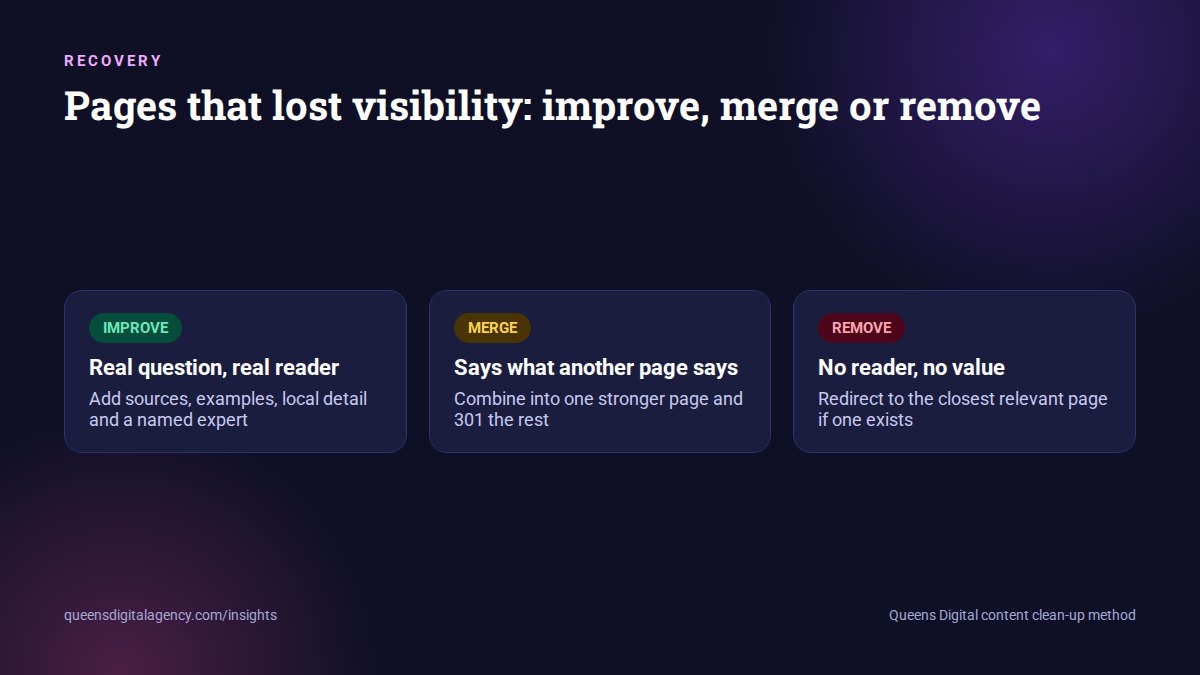
Instead, sort the affected pages into three groups.
Keep and improve
Pages that answer a real question for a real reader. Add sources, original examples, local detail and a named expert. Update anything out of date.
Merge
Pages that say the same thing as another page. Combine them into one stronger page and permanently redirect the rest. We did exactly this with three overlapping posts on our own site, which became our guide to reviews, testimonials and trust.
Remove
Pages with no real reader and no realistic way to become useful. Redirect them to the closest relevant page if one exists.
Search Engine Journal notes that recovery can take months, because Google’s systems need time to see that a site now follows its policies. Our content SEO service runs exactly this kind of clean-up.
How should you use AI for content from now on?
At Queens Digital we use Claude and ChatGPT every day. They save real time. They also make confident mistakes, so every article goes through the same process:
- Research: use AI to summarise sources, then open and read the important ones yourself.
- Outline: decide the reader’s question and the order of ideas before any drafting.
- Draft: let AI help with a first draft or with structure.
- Expert edit: a person who knows the subject rewrites anything generic and adds their own experience.
- Fact-check: every number and quote is checked against its original source and linked.
- Local detail: add what an AI draft gets wrong or leaves out, such as prices in NPR, local rules and how customers here actually decide.
- Ownership: a named author stands behind it.
AI can help write it. A person has to stand behind it.
AI-assisted content: what is fine and what invites trouble
| Practice | Usually fine | Invites trouble |
|---|---|---|
| Drafting | AI draft, rewritten and fact-checked by an expert | AI draft published unedited |
| Scale | A few deep pages on real questions | Hundreds of near-identical pages |
| Sources | Claims linked to the original source | Unsourced statistics |
| Authorship | Named author with real experience | No author, or an invented one |
| Metadata | Titles and descriptions written for readers | Auto-generated titles stuffed with keywords |
| Purpose | Written to help a reader decide | Written mainly to rank or to sway AI answers |
What does this change for AI Overviews and AI Mode?
One important thing. Because Google’s spam definition now covers manipulating generative AI responses, tactics built only to get quoted in AI answers are on notice.
That includes hidden text written for AI systems, fake comparison pages that always crown the author’s own business, and planted reviews or forum posts.
The planted-post approach was already weakening elsewhere. ChatGPT cut its Reddit citations sharply the week before this update, as we covered in our Reddit citations field note.
The honest approach has not changed: clear answers, real evidence and a site that deserves trust.
Read more: The 20% of SEO that gets you cited by AI
What is the short version for a busy business owner?
Google did not ban AI content in August. It ran a routine update enforcing rules that already existed.
Those rules punish content made at scale to game search, whoever or whatever wrote it.
If your pages are useful, sourced and owned by a real expert, keep going. If they are not, fix that first.
If you would like a second opinion, Queens Digital is a digital marketing agency in Nepal that reviews AI-assisted content as part of our SEO services in Nepal.
Explore More
Generative AI can be particularly useful when researching a topic, and to add structure to original content.
Measure with clean windows and a control series.

Reviewed by
K.K. Bhatta
K.K. Bhatta is a general digital marketer at Queens Digital Agency: hands-on across SEO, paid media, and whatever platform changes next. A lifelong learner rather than a one-topic specialist, he tests ideas on live campaigns before writing about them, and stays skeptical of anything that has not actually been tried.
Every claim in this article was checked against a live source before publishing.
It started on 18 August 2026 at 09:27 Pacific time and was complete on 21 August 2026, according to the Google Search Status Dashboard. It applied globally and to all languages.
Google has not said so. It enforced existing spam policies, which target content produced mainly to manipulate search, regardless of whether a person or AI wrote it.
Google defines it as many pages generated for the primary purpose of manipulating search rankings and not helping users. Using AI to create many pages without adding value is one example.
Yes, if the result is original, accurate and useful, and a real expert checks and stands behind it. Google says AI can be useful for research and structure.
It can take months. Fix the underlying pages, check for manual actions and give Google’s systems time to reassess the site.
Sources and references
Every claim above comes from the sources below, verified live before use. Accessed 25 September 2026.
- Google Search Status Dashboard, August 2026 spam update
- Search Engine Journal, “Google Finishes Rolling Out The August 2026 Spam Update”
- Digital Applied, “The August 2026 Spam Update Is Done. Here Is What to Measure”
- GSQi, Glenn Gabe, August 2026 spam update case studies
- Google Search Central on X, 18 August 2026
- Search Engine Land, “Google confirms spam policies apply to AI Overviews and AI Mode”
- Google Search Central, Spam policies for Google web search
- Google Search Central, Guidance on using generative AI content
- Google Search Central, Creating helpful, reliable, people-first content
- Search Console Help, Manual actions report