
Quick answer
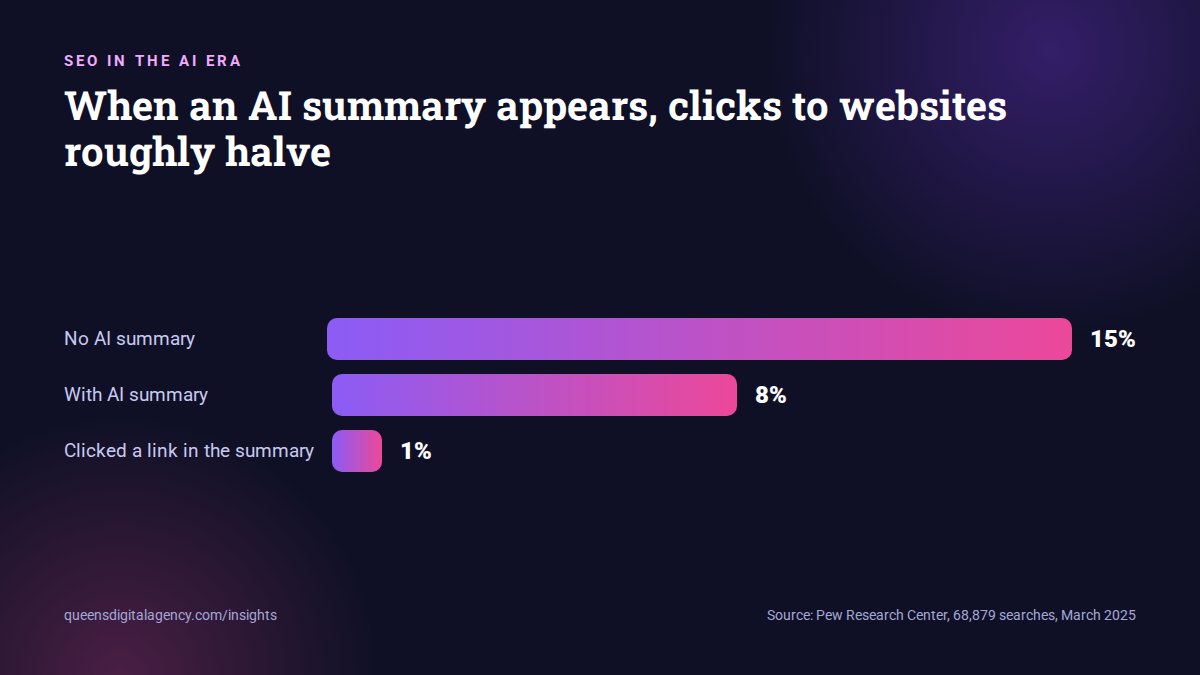
Yes, SEO is still worth paying for, but not every kind of SEO. AI summaries do reduce clicks: Pew Research found people clicked a result on 8% of visits with an AI summary, against 15% without one. But Google says optimising for its AI features is still SEO, with no special requirements, and Ahrefs found Google still sends about 190 times more traffic to websites than ChatGPT. The SEO worth paying for now builds trust, answers real buying questions and makes your business the source AI tools rely on.
Key takeaways
- AI summaries roughly halve clicks on the searches where they appear.
- Google says optimising for AI Overviews and AI Mode is still SEO. There are no extra requirements.
- Google still sends about 190 times more traffic to websites than ChatGPT, according to Ahrefs.
- Traffic-chasing blog posts are losing value. Service pages, local SEO, technical health and genuine mentions are gaining it.
- Measure SEO by enquiries, branded searches and AI mentions, not just clicks.
More business owners are asking whether SEO is still worth paying for, and it is easy to see why. They can see the change with their own eyes.
Search a simple question on Google and the answer is often right there, written by AI, above every website. Ask ChatGPT for a recommendation and you get a shortlist without visiting a single site.
So it is a fair question. If fewer people click, why keep paying someone to help you rank?
The honest answer has two parts. Some SEO work is losing value fast. Some is worth more than it was a year ago. The rest of this article separates the two.
Google’s own Search Relations team discusses how AI is changing Search and SEO, in Search Off the Record, episode 109 (May 2026).
Are AI answers really taking clicks away?
Yes. The best independent data says so.
What Pew Research found
Pew Research Center tracked the real browsing of 900 US adults in March 2025, covering 68,879 Google searches.
- With an AI summary on the page, people clicked a traditional result on 8% of visits.
- Without one, they clicked on 15%.
- Only 1% of visits involved clicking a link inside the AI summary itself.
- People ended their browsing session after an AI summary 26% of the time, against 16% without one.
What Ahrefs found in 2026
Ahrefs’ Q1 2026 AI Search Benchmark Report found that AI Overviews reduced clicks to top-ranking content by 58%, and that AI Overviews appeared for 21% of the keywords it studied.
What Google says
Google tells a different story about total traffic.
Overall, total organic click volume from Google Search to websites has been relatively stable year-over-year.
 Liz Reid, VP and Head of Google Search, Google blog, August 2025
Google also says it is sending slightly more quality clicks, meaning visits where people do not quickly bounce back. Both things can be true: fewer clicks on simple questions, steadier clicks on questions where people want detail.
So why is SEO still worth it?
Because AI answers are built on top of search, not instead of it.
Google says AI search is still SEO
From Google Search’s perspective, optimizing for generative AI search is optimizing for the search experience, and thus still SEO.
Google Search Central, guide to optimising for generative AI
Google’s AI features documentation adds that there are no additional requirements or special optimisations to appear in AI Overviews or AI Mode. A page has to be indexed and eligible to show with a snippet. That is ordinary SEO.
In other words, the same work that earns rankings is what makes you eligible to be quoted. Skip it and you are not in the pool AI answers draw from.
Google still sends far more traffic than AI chatbots
Ahrefs estimated that ChatGPT handles about 12% of Google’s search volume, but Google sends about 190 times more traffic to websites. ChatGPT’s click-through rate was 96% lower than Google’s.
Neil Patel reached a similar conclusion from a different angle: Google controlled 89% of all US web traffic in 2025, while AI and chatbot searches were roughly 6% of global search volume.
The clicks that remain are often better
The average AI search visitor is 4.4x more valuable than the traditional organic search visitor.
 Semrush, answer engine optimization guide
Which kinds of SEO are losing value?
Be honest about these, because this is where most wasted budget sits.
Generic blog posts
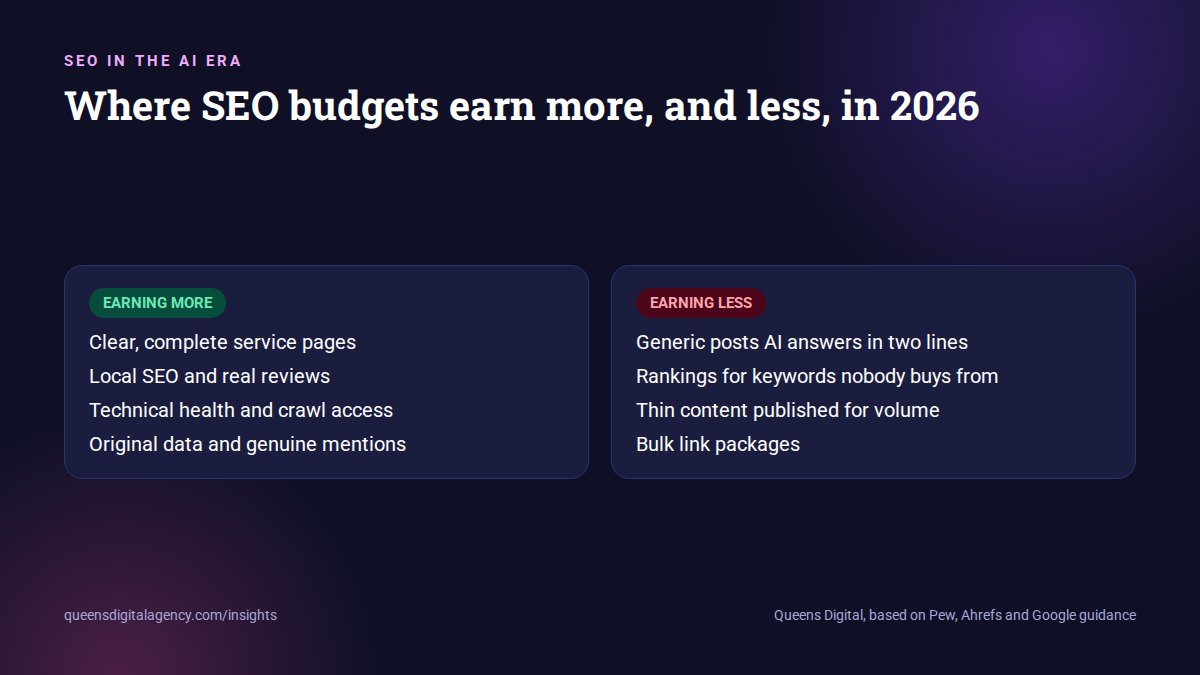
Posts answering broad questions AI can handle in two lines, such as “what is digital marketing” or “benefits of a website.” These were always weak for sales. Now they barely get clicked.
Rankings reports for keywords nobody buys from
A report showing you are first for a phrase with no buying intent looks good and pays nothing.
Volume for its own sake
Publishing lots of thin content to look busy. Google’s spam rules target pages made at scale mainly to rank, as we explained in our note on the August spam update.
Bulk links
Link packages bought by the hundred, from sites with no connection to your business. Ahrefs found backlinks correlate with AI visibility far less than genuine brand mentions do.
If most of your SEO budget goes to these, you are right to question it.
Which kinds of SEO are worth more than before?
The kinds that make you the trusted source, not just another result.
Clear, complete service pages
Pages that answer what buyers ask before they call: what you do, for whom, where, how pricing works and why you. Since August, ChatGPT has also been searching named websites directly far more often, as we covered in our Reddit citations field note. Your own pages matter more.
Local SEO
A complete Google Business Profile, real reviews and consistent listings. For clinics, consultancies, colleges and shops in Kathmandu, this is often the highest-return work of all. Our local SEO services focus here.
Technical health
A fast site that search engines and AI crawlers can read easily. Our technical SEO services cover crawl access, speed and structure.
Original content and genuine mentions
Your own prices, process, data and results, plus mentions on sites people already trust. AI tools need sources they can rely on. Be one.
What about buyers who never leave the AI answer?
This is the part many people miss.
If someone asks ChatGPT or Google for “the best consultancy for Australian student visas in Kathmandu” and gets a shortlist, you want to be on it, even if they never click.
They may phone you. They may search your name later. They may walk in.
That is SEO working. It just does not show up as a click from a search result.
How to measure it
- Branded searches in Search Console: are more people searching for you by name?
- Direct enquiries, calls and WhatsApp messages.
- A “How did you hear about us?” question on your forms.
- AI impressions in Search Console’s Generative AI performance report.
- A fixed set of buyer prompts checked in ChatGPT every month.
An example: two kinds of search
Take a typical dental clinic in Kathmandu. Someone searching “how long does teeth whitening last” will probably get an AI summary and never click. That search was never likely to produce a booking.
Someone searching “teeth whitening price in Lalitpur” or “dentist open Saturday near me” wants a clinic, a price and a phone number. Those searches still lead to visits, calls and bookings, and they depend on service pages, Google Business Profile and reviews.
Good SEO puts its effort into the second kind. Our digital marketing guide for health clinics goes deeper on this for healthcare businesses.
How should a small business split its SEO budget?
There is no universal formula, but this order works for most small and mid-sized businesses.
- Foundations first: a technically healthy site, strong service pages and a complete Google Business Profile. These keep paying back.
- Proof next: reviews, case studies and mentions on trusted sites.
- Paid search for demand you need now: Google Ads catches people ready to buy today, while SEO builds the long-term base. We explain how the two work together in SEO vs SEM, and our Google Ads management team runs both sides.
- Cut content and links that exist only to inflate a rankings report.
You can see this approach in practice in our Jeep Nepal case study, where search was judged by the enquiries it produced, not just by rankings.
SEO spend in 2026: what still pays and what to question
| Area | Still worth paying for | Worth questioning |
|---|---|---|
| Content | Pages answering real buying questions with original detail | Generic posts AI can answer in two lines |
| Local | Complete profile, real reviews, consistent listings | Buying fake or bulk reviews |
| Technical | Fast, crawlable site with clean structure | Audits that never get fixed |
| Authority | Genuine mentions on trusted sites | Bulk link packages |
| Reporting | Enquiries, branded search, AI mentions | Rankings for keywords nobody buys from |
| AI visibility | Clear answers, allowed crawlers, consistent facts | Special AI files and tricks |
How do you know your SEO agency is doing the right work?
Ask three questions at your next review.
- Which buying questions are we trying to own, and do we appear for them in Google and in AI tools?
- What did you change on our website this month, and why?
- How do our enquiries and branded searches compare with last quarter?
If the answers are vague or only about rankings, that is a warning sign.
Read more: How to find the right SEO agency
So, is SEO worth it?
If SEO means publishing more pages to chase more clicks, less and less.
If SEO means making your business the clearest, most trustworthy answer for the questions your customers ask, more than ever.
AI did not end SEO. It ended the lazy version of it.
If you want a team to do the version that still works, Queens Digital is a digital marketing agency in Nepal and our SEO services in Nepal are built around exactly these priorities.
Explore More
From Google Search’s perspective, optimizing for generative AI search is optimizing for the search experience, and thus still SEO.
Google sends 190x more traffic to websites than ChatGPT. ChatGPT’s CTR is 96% lower than Google’s CTR.

Reviewed by
K.K. Bhatta
K.K. Bhatta is a general digital marketer at Queens Digital Agency: hands-on across SEO, paid media, and whatever platform changes next. A lifelong learner rather than a one-topic specialist, he tests ideas on live campaigns before writing about them, and stays skeptical of anything that has not actually been tried.
Every claim in this article was checked against a live source before publishing.
No. Google says optimising for its AI features is still SEO, and Google still sends far more traffic to websites than AI chatbots. What is losing value is generic, traffic-chasing content.
Yes. Pew Research found people clicked a traditional search result on 8% of visits when an AI summary appeared, compared with 15% when it did not.
No. Google says there are no additional requirements. Pages must be indexed and eligible to show with a snippet, which is standard SEO.
Yes, when it focuses on foundations: a healthy site, clear service pages, local SEO, reviews and genuine mentions. Measure it by enquiries and branded searches as well as clicks.
Ahrefs estimated ChatGPT has about 12% of Google’s search volume, but Google sends about 190 times more traffic to websites.
Sources and references
Every claim above comes from the sources below, verified live before use. Accessed 25 September 2026.
- Pew Research Center, “Google users are less likely to click on links when an AI summary appears in the results”
- Google Search Central, Optimizing for generative AI in Google Search
- Google Search Central, AI features and your website
- Google, “AI in Search is driving more queries and higher quality clicks,” Liz Reid
- Ahrefs, “ChatGPT Has 12% of Google’s Search Volume but Google Sends 190x More Traffic”
- Business Wire, Ahrefs Q1 2026 AI Search Benchmark Report
- Semrush, “What Is Answer Engine Optimization?”
- Neil Patel, “Is SEO Dead in 2026?”
- Google Search Central, Search Off the Record episode 109 on YouTube