Quick answer
Entity SEO means making the facts about your business (name, address, phone, website, services, people and official profiles) clear and identical everywhere, so Google and AI assistants recognise you as one entity and describe you correctly. Write one brand fact sheet, make your website and About page match it, add Organization schema with sameAs links to profiles you control, fix every directory listing, and claim or correct your Knowledge Panel where Google allows it.
Key takeaways
- Write one brand fact sheet and check every listing against it.
- Name spelling and address format are the most common inconsistencies.
- Organization schema has no required properties; put it on the home or About page.
- sameAs should list only official profiles you control and keep active.
- Local businesses manage their panel through Google Business Profile.
- You cannot buy a Knowledge Panel; consistent, referenced facts come first.
Ask ChatGPT or Gemini about your business and read the answer slowly. Is the phone number right? The address? Does it say you still offer a service you dropped two years ago, or mix you up with a company with a similar name? Those answers are assembled from what the web says about you. When the facts disagree, the answer is a guess.
Entity SEO is the work of making those facts clear and consistent, so Google and AI assistants recognise your business as one specific thing and describe it correctly. This guide covers the practical side: a brand fact sheet, Organization schema with sameAs, directory listings, your About page and the Knowledge Panel. It is also the foundation of the AI SEO and GEO work we do at Queens Digital, a Nepal-based SEO and AI/GEO agency.
What is entity SEO?
An entity is a thing search engines can identify on its own terms: a person, a place, an organisation, a product. Google calls the boxes it shows for these things knowledge panels, and says the information in them “comes from various sources across the web” and updates automatically as that information changes (Google, About knowledge panels).
So entity SEO is less about keywords and more about identity. You are answering three questions for every system that reads about you:
- Who are you? One name, one legal entity, one website.
- Where and how can people reach you? Address, phone, opening hours, service area.
- What do you do, and who vouches for it? Services, founders, memberships, and the independent sites that describe you.
AI assistants lean on the same signals. We have written about why AI tools recommend one business over another; contradictory details are one of the reasons a smaller, clearer competitor gets named instead of you. Google itself says there are no special optimisations needed for AI Overviews, but it does ask site owners to keep Business Profile information up to date and structured data matching the visible text (Google, AI features and your website).
Start with a brand fact sheet
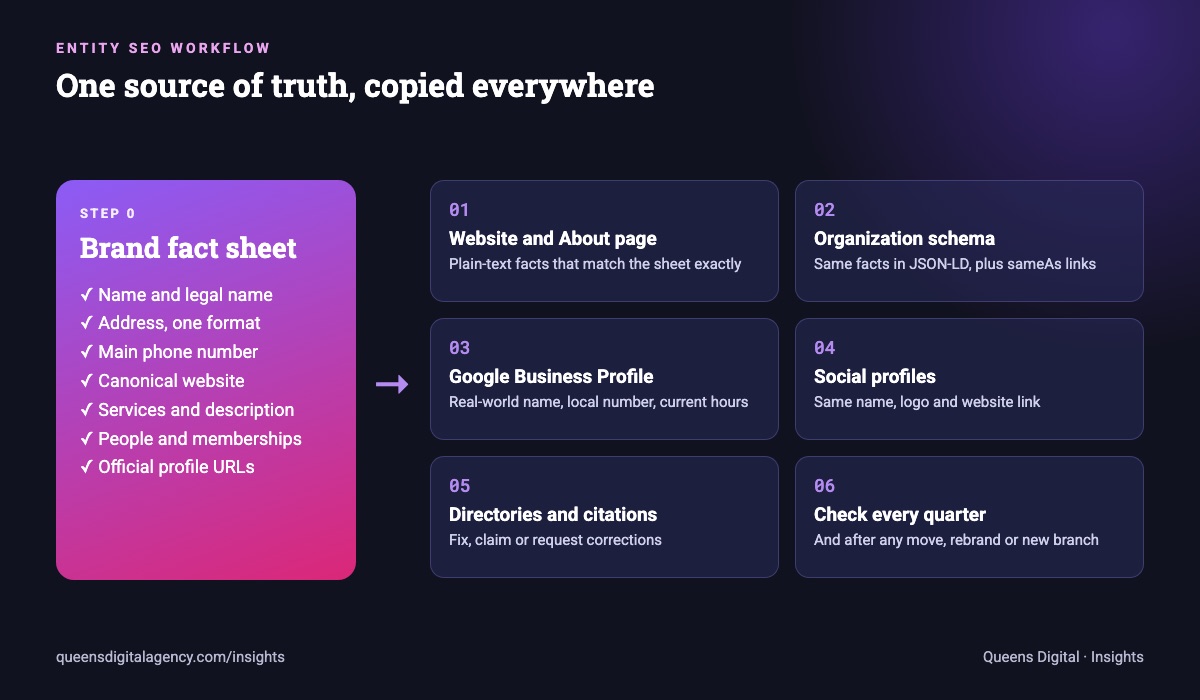
Before touching schema or directories, write down the one true version of every fact. We keep this as a single shared document for each client, and every listing is checked against it. It sounds basic. In our audits, it is where most problems start.
- Name: the exact trading name, plus the registered legal name if it differs (for example with or without “Ltd”, “LLC” or “Pvt. Ltd.”). Pick one public spelling, plus one spelling per language or script you trade in, and use them everywhere.
- Address: one format, copied rather than retyped: suite or floor, street, area, city, postcode. Where streets have no numbers the problem is worse; in Nepal, for example, the same office is often written five ways using a landmark, tole and ward number, so fixing one version matters even more.
- Phone: one main number. Google asks for a number “under the direct control of the business” and a local number rather than a call-centre line where possible (Google Business Profile guidelines).
- Website: one canonical domain (https, www or not). If you changed domain, every profile must point to the new one.
- Description and services: a two-sentence description and the current service list. Retire old services everywhere at once.
- People and proof: founders, founding year, licences, association memberships, awards you can document.
- Official profiles: the URLs of the social and directory profiles you control. These become your
sameAslist.
Where brand facts usually go wrong
| Fact | Common problem | Fix |
|---|---|---|
| Business name | Ltd or Pvt. Ltd. added on some listings, dropped on others; two spellings | One public name, one legal name, one spelling per language |
| Address | Suite, landmark or area written differently on every site | One fixed format, copied, never retyped |
| Phone | Old landline on Facebook, staff mobile on directories | One main number the business controls |
| Website | Old domain or http links on profiles after a migration | Every profile links to the current canonical URL |
| Services | Dropped services still listed on old profiles | One current list, updated everywhere at once |
| Official profiles | Duplicate or abandoned pages | Claim, merge or close; list live ones in sameAs |
Organization schema and sameAs
Organization structured data tells Google, in machine-readable form, the facts from your sheet. Google’s Organization markup guide says it can help Google understand your organisation’s administrative details, and that the logo can influence visual elements such as the knowledge panel. Three points from that guide matter most:
- There are no required properties. Add the ones that genuinely apply, starting with name, url, logo, address and telephone.
- Put it on the home page or one page about the organisation, such as the About page. It does not need to be on every page.
sameAslists pages on other sites with more information about you, such as social or review profiles. Schema.org defines it as the URL of a page that “unambiguously indicates the item’s identity” (schema.org, sameAs).
{
  "@context": "https://schema.org",
  "@type": "Organization",
  "name": "Example Dental Clinic",
  "legalName": "Example Dental Clinic LLC",
  "url": "https://www.example.com/",
  "logo": "https://www.example.com/logo.png",
  "telephone": "+1-555-010-0000",
  "address": {
    "@type": "PostalAddress",
    "streetAddress": "2nd Floor, 14 Market Street",
    "addressLocality": "Springfield",
    "postalCode": "00000",
    "addressCountry": "US"
  },
  "sameAs": [
    "https://www.facebook.com/exampledental",
    "https://www.linkedin.com/company/exampledental",
    "https://www.youtube.com/@exampledental"
  ]
}
Two rules keep this honest. Google’s structured data policies say markup must be “a true representation of the page content”, so every fact in the code should also be visible on the page. And list only profiles you control and keep active; a dead Twitter account in sameAs adds confusion, not trust. Local businesses can use a more specific type such as LocalBusiness or Dentist, which inherits the same properties. Schema is a supporting signal, not a shortcut: our piece on why AI Overviews skip some sites explains why the page itself has to earn the citation.
Directory and citation consistency
A citation is any mention of your business details on another site. Most businesses have far fewer important citations than they fear, which makes the job manageable. Work through them in this order:
- Google Business Profile. The most important listing. Google says your name should reflect your real-world name, and that adding unnecessary information to it isn’t permitted, so no keywords or city names stuffed into the title. Our Google Business Profile optimisation guide covers the full setup.
- Facebook and Instagram. In our audits, the Facebook page is often the profile customers use most, and the place where the oldest phone number survives.
- LinkedIn, YouTube and TikTok, if you use them. Same name, same logo, same website link.
- Associations and regulators. Member lists from trade bodies and chambers are trusted sources. Check how they spell your name.
- Marketplaces, booking sites and local directories. Amazon or regional marketplaces, travel and booking platforms, review sites, and the local business directories that rank for your name.
- News and partner sites. You cannot edit these, but you can ask for a correction when a fact is wrong.
Our routine: search your brand name in Google and in two or three AI assistants, list every page that states a fact about you, compare each against the fact sheet, then fix, claim or request corrections, starting with the sources that appear first. Recheck after any move, rebrand, new branch or new phone number. Google notes that local prominence is based partly on how many websites link to you and how many reviews you have (Google, Tips to improve your local ranking), so a clean, well-referenced profile helps on Maps as well.
Your About page: the reference copy
When systems find conflicting facts, your own site should be the clearest version. The About page is the natural home for that, and it is one of the places Google suggests for Organization markup. A useful About page states, in plain text:
- the full business name and legal name, founding year and who runs it;
- the address, phone and email exactly as on the fact sheet, and branch addresses if you have several;
- what you do, for whom, and where, in a few sentences;
- licences, memberships and awards, with links to the bodies that grant them;
- links to your official profiles, matching the
sameAslist.
Keep it current. An About page that still names a founder who left, or a branch that closed, is a source of the exact contradictions you are trying to remove. If people write for your site, give them author pages too; they help both readers and machines connect your content to real experts.
The Knowledge Panel: claim it, correct it, be patient
Not every business gets a knowledge panel, and you cannot buy one. What you can do is make your facts consistent and well referenced, then manage the panel if it appears.
- Local businesses with a location or service area manage their Search and Maps panel through Google Business Profile, which Google recommends over the knowledge panel claim process (Google, Get verified on Google).
- Brands and organisations with a knowledge panel can click “Claim this knowledge panel” and verify by signing in to an official site or profile, such as Search Console or YouTube. Google notes that not all panels are claimable yet.
- Anyone can suggest a correction through the feedback link on the panel. Google reviews it.
Wikipedia and Wikidata are common sources for panels, but they have their own rules. Wikidata, for example, expects an item to be supported by serious, publicly available references (Wikidata notability policy). Do not create or edit entries about your own company to promote it; earn the independent coverage first. That is where digital PR and other off-page work come in.
Entity SEO in practice
Our Goreto Educational Consultancy case study shows this work alongside the rest of the plan. Goreto, a study-abroad consultancy, has six offices and moved to a new goreto.edu.np domain. That is exactly the situation where branch addresses, phone numbers and website links drift apart. The work included consistent listings for the branch network and entity and authority work for AI answers, and Goreto is now cited more often in AI answers about choosing a consultancy.
If you want to do it yourself, the order is: fact sheet, website and About page, Organization schema, Google Business Profile, social profiles, then directories and corrections. Do the first three in a day; the rest takes a few weeks of steady checking.
Want a second opinion on your site? Ask us for a free SEO review and we will tell you what to fix first, in plain language.
Explore More
Reviewed by
K.K. Bhatta
K.K. Bhatta is a general digital marketer at Queens Digital Agency: hands-on across SEO, paid media, and whatever platform changes next. A lifelong learner rather than a one-topic specialist, he tests ideas on live campaigns before writing about them, and stays skeptical of anything that has not actually been tried.
Every claim in this article was checked against a live source before publishing.
Entity SEO is the work of making the facts about your business clear and consistent across your website, structured data and third-party profiles, so search engines and AI assistants recognise you as one specific organisation and describe you accurately.
NAP stands for name, address and phone number. NAP consistency means those details are written the same way on your website, Google Business Profile, social profiles and directories, so nobody has to guess which version is correct.
It is not required, and Google says Organization markup has no required properties. It helps Google understand your administrative details, and the logo can influence visual elements such as the knowledge panel. Consistent facts across the web matter more.
Search for your business, click “Claim this knowledge panel” if it appears, and verify by signing in to an official site or profile such as Search Console or YouTube. Local businesses should manage their information through Google Business Profile instead.
We check them quarterly, and straight away after a move, rebrand, new branch, new phone number or domain change.
Sources and references
Facts in this guide come from the sources below, checked live on 8 November 2026. Everything else is our own working practice, stated as such.
- Google Search Help, About knowledge panels
- Google Search Help, Get verified on Google
- Google Search Central, Organization structured data
- Google Search Central, General structured data guidelines
- Google Search Central, AI features and your website
- Schema.org, sameAs property
- Google Business Profile Help, Guidelines for representing your business
- Google Business Profile Help, Tips to improve your local ranking
- Wikidata, Notability policy