
Quick answer
Content consolidation means merging several blog posts that cover the same topic into one stronger page, then permanently redirecting the old URLs to it. It helps because overlapping posts split links, relevance and readers between them, and often repeat each other with inconsistent claims. Google treats a permanent redirect as a signal that the target should be the canonical page. For many business blogs, one careful cleanup does more than publishing ten new posts, though Google’s John Mueller notes merged pages can take time to settle.
Key takeaways
- Overlapping posts compete with each other, split links and often contradict each other.
- Merging means one survivor page, rewritten properly, with 301 redirects from the rest.
- Google treats a permanent redirect as a signal that the target should be canonical.
- Merges take longer to settle than simple site moves, so give them time.
- One definitive page is easier for Google and AI tools to trust than several thin ones.
For years the advice was simple: publish often. So many businesses did.
The result, on a lot of sites, is a blog full of posts that say nearly the same thing. Three articles about reviews. Four lists of “tips.” Two posts on the same service with slightly different titles.
Each one is a little thin. None of them is the obvious best answer.
Search engines and AI tools have to pick one. Often they pick none.
How this happens
- Different writers covering the same topic over the years.
- Keyword lists that treat every small variation as a new article.
- Publishing targets that reward volume over usefulness.
- AI tools that make it easy to produce another similar post in minutes.
What does overlap actually cost you?
Split authority
Links and mentions spread across several URLs instead of strengthening one.
Pages competing with each other
Two or three of your own pages take turns ranking for the same search, and none ranks as well as one combined page would.
Weak answers
Readers land on a thin version and leave to find a better answer elsewhere.
Contradictions
Repeated claims drift. One post says 88%, another says 92%, and neither cites a source. That damages trust with readers and with AI tools that look for consistent facts.
Stale pages
Every extra page needs updating, and most never are. Freshness matters for AI answers: Semrush, citing an AirOps study, reports that 95% of ChatGPT citations come from content published or updated within the last 10 months, and that pages with a clear last-updated date receive 1.8 times more citations. We covered why in the 20% of SEO that gets you cited by AI.
What did our own cleanup look like?
We did exactly this on our own site in August 2026.
The problem
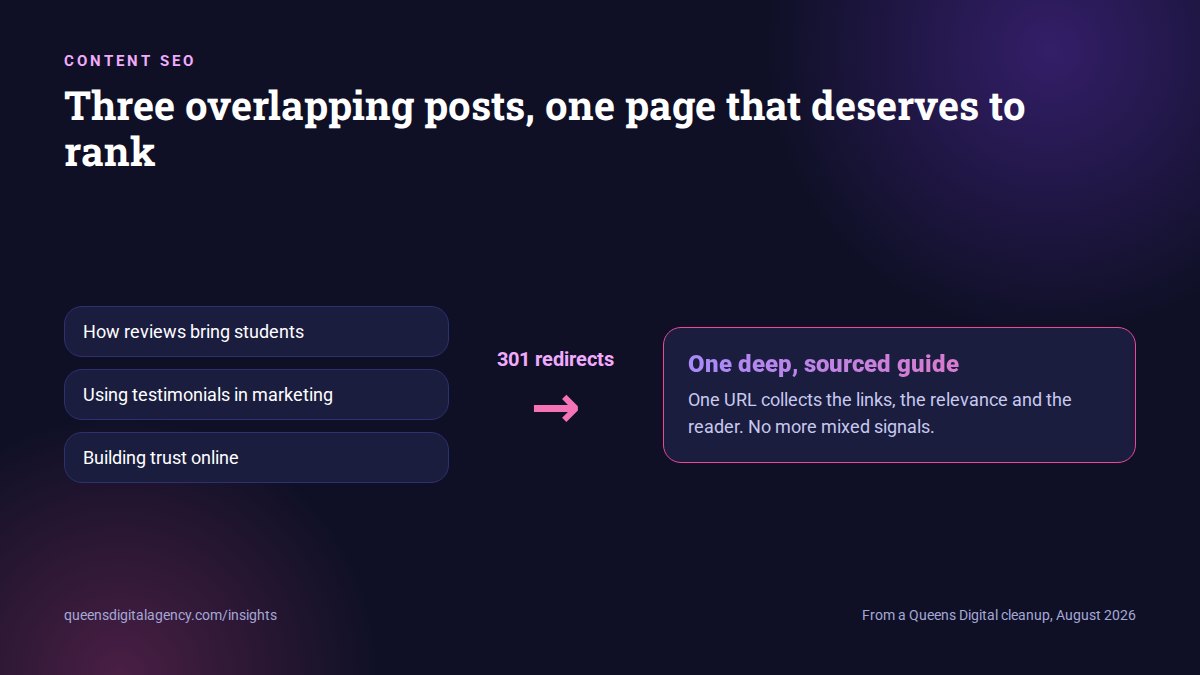
Our education consultancy series had three posts covering the same ground: one on reviews, one on testimonials and one on building trust online. They repeated the same advice and quoted different, unsourced percentages for the same kind of claim. One of them was not even linked from the rest of the series.
What we did
- Kept the strongest URL, the one already linked from the series hub.
- Rewrote it into one deep guide, replacing loose statistics with properly sourced figures.
- Permanently redirected the other two posts to it.
- Updated the hub so it linked only to the surviving guide.
The result
Three weak pages became one page worth reading: our guide to reviews, testimonials and trust for education consultancies. It is now the single, clear answer on that topic for readers, Google and AI tools.
How do you find posts that should be merged?
Use two tests on each group of similar posts.
Test 1: different need or format?
Do the posts serve genuinely different reader needs? “Mistakes to avoid” and “how to set it up” can live side by side. “Reviews build trust” and “testimonials build trust” cannot.
Test 2: would a reader lose anything?
If two posts became one, would anything useful disappear? If not, merge them.
Practical signs of overlap
- Similar titles, or the same main keyword.
- Two URLs taking turns ranking for the same search in Search Console’s Performance report.
- Headings that repeat across posts.
- Posts with almost no traffic on a topic another post covers better.
- Statistics that disagree between posts.
How do you merge posts without losing traffic?
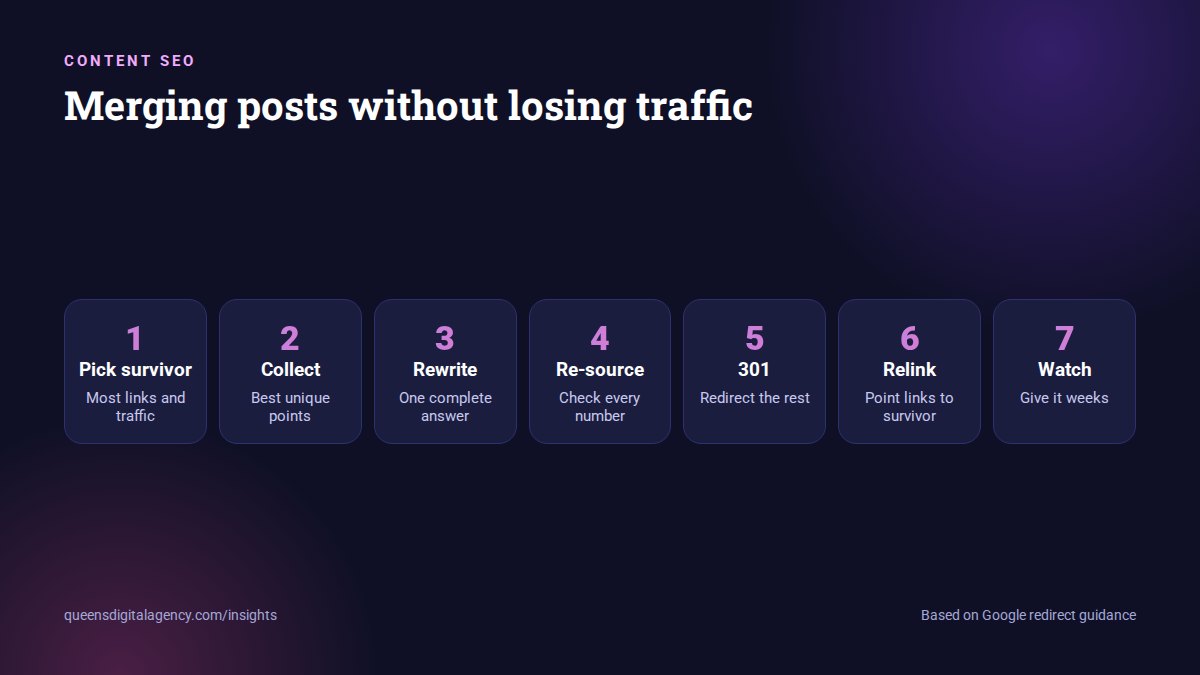
- Pick the survivor. Usually the URL with the most links and traffic, or the clearest slug.
- Collect the best material. Pull every useful, unique point from each post in the group.
- Rewrite, do not paste. Build one complete answer with a clear structure. Stitched-together sections read badly and repeat themselves.
- Check every statistic. Trace each number to its original source. Remove anything you cannot source.
- Redirect. Add a 301 redirect from each retired URL to the survivor.
- Fix internal links. Point links across your site straight at the survivor, not through the redirects.
- Check in Search Console. Request indexing of the survivor and watch it for a few weeks.
Googlebot follows the redirect, and the indexing pipeline uses the redirect as a signal that the redirect target should be canonical.
 Google Search Central, Redirects and Google Search
That is how the old pages’ value flows to the new one.
How long does a merge take to settle?
Longer than most people expect. Google’s John Mueller answered exactly this question when an SEO asked why an old page still appeared two weeks after merging:
John Mueller on Bluesky, January 2025. View the post.
What to expect
- The survivor may take several weeks to fully absorb the old pages’ queries.
- Old URLs can still appear if someone searches for them specifically. That is normal.
- Rankings can wobble before they settle. Do not undo the merge in the first month.
Keep the redirects in place permanently. Google’s advice is to use permanent redirects when you are sure they will not be reverted.
When should you delete instead of merge?
When there is nothing worth keeping.
- No traffic, no links and no unique information.
- No realistic reader for the topic.
- Content that is outdated beyond saving, such as an old event or discontinued service.
Even then, redirect the URL to the closest relevant page if one exists. It costs nothing and catches any stray visitors or links. Only let a page return 404 or 410 when there is truly no sensible destination.
Merge, keep or remove: a quick decision guide
| Situation | Decision | Why |
|---|---|---|
| Two posts, same intent, both thin | Merge | One stronger page beats two weak ones |
| Two posts, different intent or format | Keep both | They serve different reader needs |
| Post with links but outdated content | Update and keep | Its links are worth preserving |
| Post with no traffic, links or unique value | Remove and redirect | Nothing to lose, less to maintain |
| Posts quoting conflicting statistics | Merge and re-source | Inconsistency damages trust |
| Many near-identical location or keyword pages | Consolidate urgently | This pattern can look like scaled content abuse |
How does a cleanup help with AI search?
AI tools look for clear, trustworthy answers. One definitive page is easier to trust than five contradictory ones.
Does the content provide a substantial, complete, or comprehensive description of the topic?
Google Search Central, Creating helpful, reliable, people-first content
Merged pages are built to answer yes. They also reduce the risk of looking like scaled content, which Google’s spam policies define as many pages made mainly to manipulate rankings. We explained why that matters in our note on the August spam update.
There is no need to chop pages into tiny pieces for AI either. Google’s generative AI guidance says there is no requirement to break content into small chunks for AI to understand it.
Read more: What AI sees when it picks between you and a competitor
How often should you do a cleanup?
Once a year is enough for most business blogs. Twice if you publish a lot.
Build it into your content plan. Before writing any new post, check whether an existing page already covers the topic. If one does, improve that page instead.
This check is a standard part of our content SEO services. If you want your blog reviewed, Queens Digital is a digital marketing agency in Nepal, and content audits are part of our SEO services in Nepal.
Your blog is not judged by how many posts it has. It is judged by whether it has the best answer.
Explore More
Googlebot follows the redirect, and the indexing pipeline uses the redirect as a signal that the redirect target should be canonical.
Merging is always a bit more challenging than a simple site-move, I’d just give it time.

Reviewed by
K.K. Bhatta
K.K. Bhatta is a general digital marketer at Queens Digital Agency: hands-on across SEO, paid media, and whatever platform changes next. A lifelong learner rather than a one-topic specialist, he tests ideas on live campaigns before writing about them, and stays skeptical of anything that has not actually been tried.
Every claim in this article was checked against a live source before publishing.
Merging several pages that cover the same topic into one stronger page, then permanently redirecting the old URLs to it.
Not if you do it carefully. Use 301 redirects, update internal links and make the new page genuinely better. Expect some movement while Google settles, which can take several weeks.
Look for posts with the same main keyword, repeated headings, disagreeing statistics, or URLs that take turns ranking for the same search in Search Console.
Longer than a simple site move. Google’s John Mueller advises giving it time, and old URLs may still appear if someone searches for them directly.
If they have no links, no unique information and no realistic reader, yes. Redirect them to the closest relevant page if one exists.
Sources and references
Every claim above comes from the sources below, verified live before use. Accessed 25 September 2026.
- Google Search Central, Redirects and Google Search
- John Mueller on Bluesky, 24 January 2025
- Google Search Central, Creating helpful, reliable, people-first content
- Google Search Central, Spam policies for Google web search
- Google Search Central, Optimizing for generative AI in Google Search
- Semrush, “What Is Answer Engine Optimization?”