Quick answer
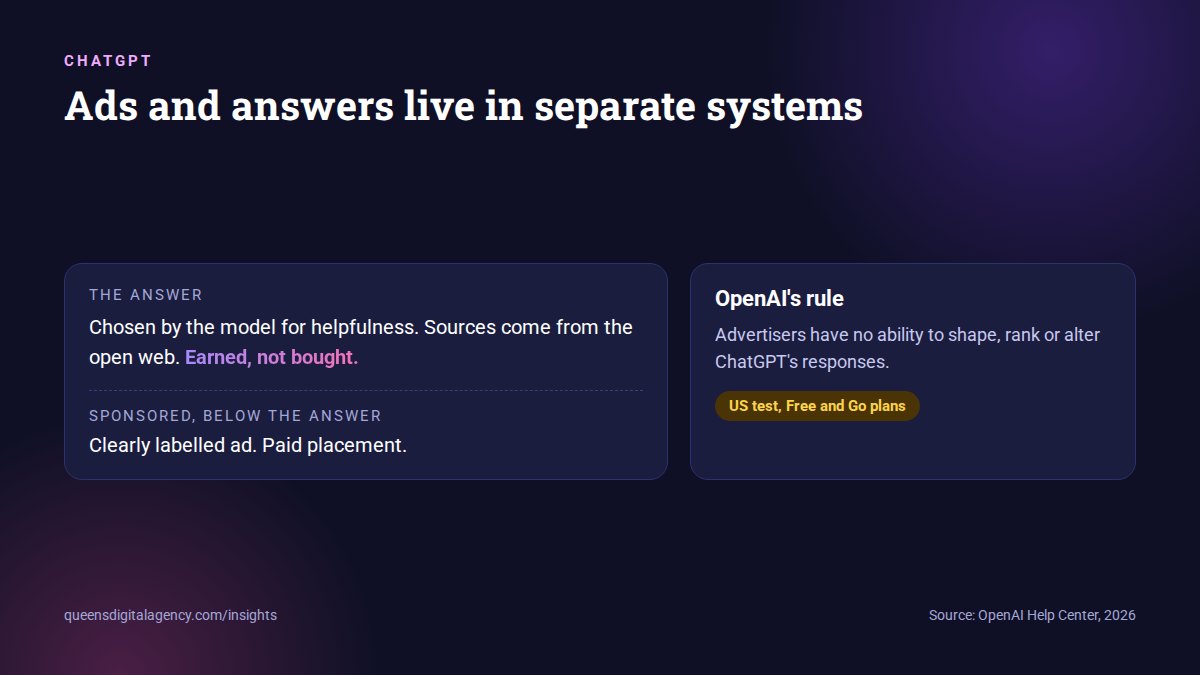
You can pay for an ad in ChatGPT, but you cannot pay to appear in ChatGPT’s answers. OpenAI says ads run on separate systems from its chat model, and advertisers have no ability to shape, rank or alter responses. Ads appear clearly labelled below an answer, only for logged-in adult users on the Free and Go plans in markets where ads are live. By August 2026 that meant the US plus eight more countries, not Nepal. Being mentioned inside the answer still has to be earned through a trusted, consistent presence on the web.
Key takeaways
- ChatGPT ads are labelled, sit below the answer and only reach Free and Go users in selected countries.
- OpenAI says advertisers cannot shape, rank or alter ChatGPT’s answers.
- By August 2026 ads ran in the US, UK, Canada, Australia, New Zealand, Japan, South Korea, Mexico and Brazil. Nepal was not included.
- Mentions inside the answer are earned: crawlable pages, clear answers, consistent details and trusted mentions.
- For most Nepali businesses, Google Ads and Meta remain the practical paid channels today.
ChatGPT started showing ads in 2026, and the news travelled fast.
The question we now hear most is whether a business can “buy ChatGPT” the way it buys Google Ads, so ChatGPT recommends it.
It is a reasonable question. It rests on one wrong assumption, though: that the ad and the answer are the same thing.
They are not. Understanding the difference will save you money and a lot of confusion.
OpenAI announcing the start of its ads test on 9 February 2026. View the post on X.
How do ads in ChatGPT actually work?
OpenAI announced its approach on 16 January 2026 and began testing in the US on 9 February. Here is what its Help Center and test announcement say.
Who sees ads
- Logged-in adult users on the Free and Go plans. Users under 18 are excluded.
- Plus, Pro, Business, Enterprise and Edu accounts see no ads.
- By August 2026 the test covered the US, UK, Canada, Australia, New Zealand, Japan, South Korea, Mexico and Brazil.
Where ads appear
- At the bottom of an answer, clearly labelled as sponsored and visually separate from the response.
- Only when a relevant product or service matches the conversation.
- Never in conversations about personal health, mental health or politics.
What advertisers get
Businesses can apply through OpenAI’s advertiser page. OpenAI says advertisers only receive aggregate performance data, such as views or clicks, and that it vets advertisers to keep out scams and misleading ads.
What users can do
Users can hide ads, see their ad history, turn off personalisation, or choose an ads-free mode with lower usage limits.
Do ads influence what ChatGPT says?
OpenAI says no, as plainly as a company can.
Ads do not influence ChatGPT’s answers. Ads run on separate systems from our chat model, and advertisers have no ability to shape, rank, or alter ChatGPT’s responses.
 OpenAI Help Center, Ads in ChatGPT
Its advertising principles add that answers are optimised for what is most helpful to the user, and that ads are always separate and labelled. OpenAI’s chief executive made the same promise when the test was announced.
Sam Altman on OpenAI’s ad principles, 16 January 2026. View the post on X.
So an ad can put your business below an answer. It cannot put your business inside it.
What is the difference between an ad, a mention and a citation?
Three different things, often confused.
A mention
ChatGPT names your business in the answer itself: “Popular options include…”
A citation
ChatGPT links to your page as a source for what it wrote.
An ad
A paid placement shown below the answer and marked as sponsored.
Mentions and citations are chosen by the model based on what it finds relevant and trustworthy. Nobody pays for them. That is exactly why people trust them more: a recommendation inside the answer feels like advice, while a labelled ad feels like an ad.
Should your business advertise in ChatGPT?
For most businesses in Nepal, not yet, for three practical reasons.
1. Availability
By August 2026, ads were running in nine countries, and Nepal was not one of them. Advertisers can target users in live markets, which matters only if you sell to those markets.
2. Cost
Early coverage from Zen Media estimated around $60 CPM with minimum commitments near $200,000 for early access. Those figures may change, but the entry point was clearly built for large advertisers.
3. Better-proven channels
Google Ads and Meta already let you target Nepal, measure enquiries and start small. Ahrefs also found Google sends about 190 times more traffic to websites than ChatGPT. Our Google Ads management and Facebook and Instagram ads management teams can help you get the most from those first.
If you sell to customers in the US, UK, Australia or another live market, a small test can make sense once your other channels are measured properly.
If you do sell into a live market
- Get your tracking right first, so you can compare ChatGPT ads with Google and Meta on cost per enquiry, not just clicks.
- Start with the conversations where your product genuinely helps. Ads are matched to the topic of the chat, so vague offers will not show.
- Send clicks to a page that answers the question the user was asking, not your homepage.
- Judge results over weeks, not days. Early tests on any new ad platform are noisy.
Our conversion rate optimisation team can help make sure the landing page is ready before you spend.
How do you get mentioned inside ChatGPT's answers?
The same way you earn trust anywhere online. There is no shortcut, but there is a clear order.
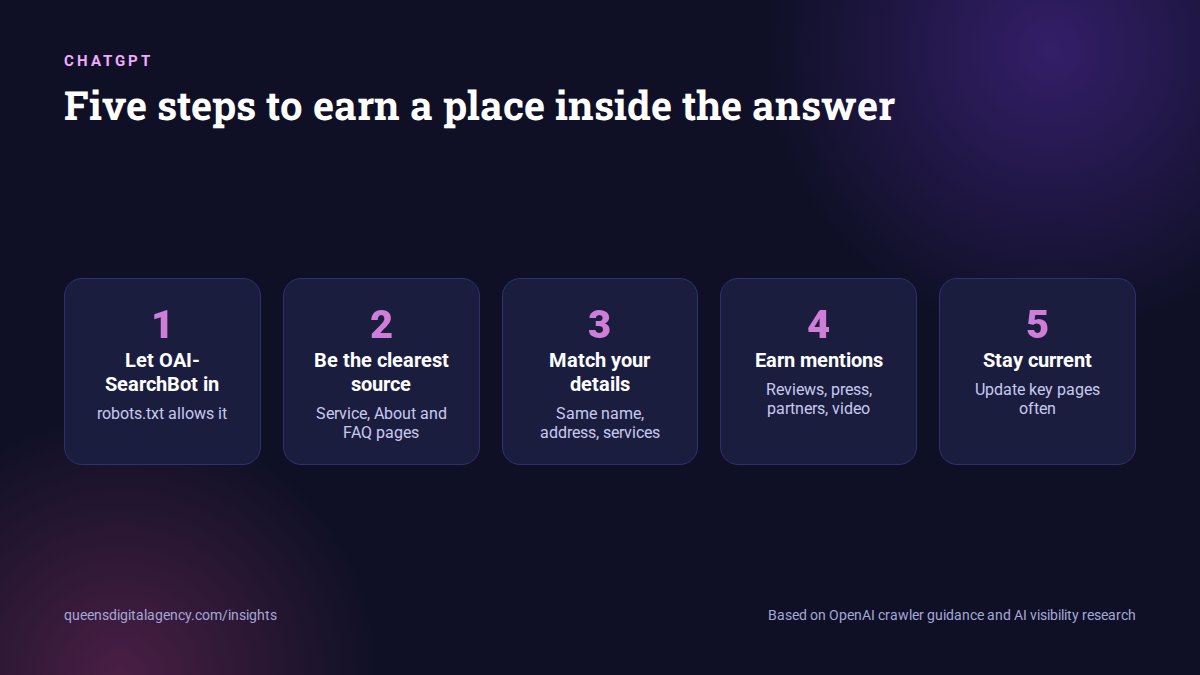
1. Let OpenAI’s search crawler in
To help ensure your site appears in search results, we recommend allowing OAI-SearchBot in your site’s robots.txt file.
OpenAI, Overview of OpenAI crawlers
2. Make your website the clearest source about you
Since August, ChatGPT has been searching named websites directly far more often, as we explained in our Reddit citations field note. Service pages, an About page with real facts, and FAQs that answer buyers’ questions all help.
3. Keep your business details identical everywhere
Same name, address, phone number and services on your site, Google Business Profile and directories.
4. Earn mentions on trusted sites
Reviews, directories, press, partner sites and video. These tell AI tools that other people vouch for you.
5. Keep important pages current
Stale information is easy to skip. We covered why freshness matters in the 20% of SEO that gets you cited by AI.
This is the work our AI SEO and GEO services do every month, and you can see it applied in our Goreto Educational Consultancy case study.
How do you know if ChatGPT already mentions you?
Ask it, systematically.
- Write down 10 to 15 questions a customer asks before choosing a business like yours.
- Run them in ChatGPT once a month, in a fresh chat.
- Record whether you are named, which competitors are named, and which sources are linked.
- Compare with Google: Search Console’s Generative AI report shows how often Google’s AI features show your pages.
Related: How to see your AI Overview and AI Mode impressions in Search Console
If competitors keep appearing and you do not, look at the sources ChatGPT links to. That shows you where your presence is missing.
ChatGPT ads versus earned mentions
| ChatGPT ad | Mention or citation in the answer | |
|---|---|---|
| How you get it | Pay OpenAI | Earn it through a trusted web presence |
| Where it appears | Below the answer, labelled sponsored | Inside the answer text or its sources |
| Who sees it | Free and Go users in live markets | Any user whose question fits |
| Available for Nepal? | Not as of August 2026 | Yes |
| Can money influence it? | Yes, that is the product | No, according to OpenAI |
| How users perceive it | As an advertisement | As a recommendation |
Is this likely to change?
Ad formats and markets will keep expanding. OpenAI’s own updates show the rollout moving country by country.
What OpenAI has staked its reputation on is the separation between ads and answers. Both its official account and its chief executive made that promise publicly.
If that ever changed, it would be major news. Until then, plan on answers staying earned and ads staying separate.
What is the bottom line?
You can buy space next to ChatGPT’s answers in some countries. You cannot buy your way into them anywhere.
For most businesses, the better investment is becoming the obvious, well-documented choice in your field. That helps in Google, in ChatGPT and with the people who make the final decision.
Queens Digital is a digital marketing agency in Nepal that works on both sides: paid media through our PPC management services, and earned visibility through our SEO services in Nepal.
Read more: Is SEO still worth paying for when AI answers everything?
Explore More
Ads do not influence ChatGPT’s answers. Ads run on separate systems from our chat model, and advertisers have no ability to shape, rank, or alter ChatGPT’s responses.
Most importantly, we will not accept money to influence the answer ChatGPT gives you, and we keep your conversations private from advertisers.

Reviewed by
K.K. Bhatta
K.K. Bhatta is a general digital marketer at Queens Digital Agency: hands-on across SEO, paid media, and whatever platform changes next. A lifelong learner rather than a one-topic specialist, he tests ideas on live campaigns before writing about them, and stays skeptical of anything that has not actually been tried.
Every claim in this article was checked against a live source before publishing.
No. OpenAI says ads run on separate systems and advertisers cannot shape, rank or alter ChatGPT’s responses. Ads appear separately and are labelled as sponsored.
Logged-in adult users on the Free and Go plans in markets where ads are live. Plus, Pro, Business, Enterprise and Edu accounts do not see ads.
Not as of August 2026. The test covered the US, UK, Canada, Australia, New Zealand, Japan, South Korea, Mexico and Brazil.
At the bottom of an answer, clearly labelled, when a relevant product or service matches the conversation. They are not shown for health, mental health or political topics.
Allow OpenAI’s search crawler, make your website the clearest source about your business, keep details consistent everywhere, and earn reviews and mentions on trusted sites.
Sources and references
Every claim above comes from the sources below, verified live before use. Accessed 25 September 2026.
- OpenAI Help Center, Ads in ChatGPT
- OpenAI, “Testing ads in ChatGPT”
- OpenAI, “Our approach to advertising and expanding access to ChatGPT”
- OpenAI on X, 9 February 2026
- Sam Altman on X, 16 January 2026
- OpenAI, Overview of OpenAI crawlers
- Zen Media, “ChatGPT Ads and Citations in AI Answers: What We Know So Far”
- Ahrefs, “ChatGPT Has 12% of Google’s Search Volume but Google Sends 190x More Traffic”