Quick answer
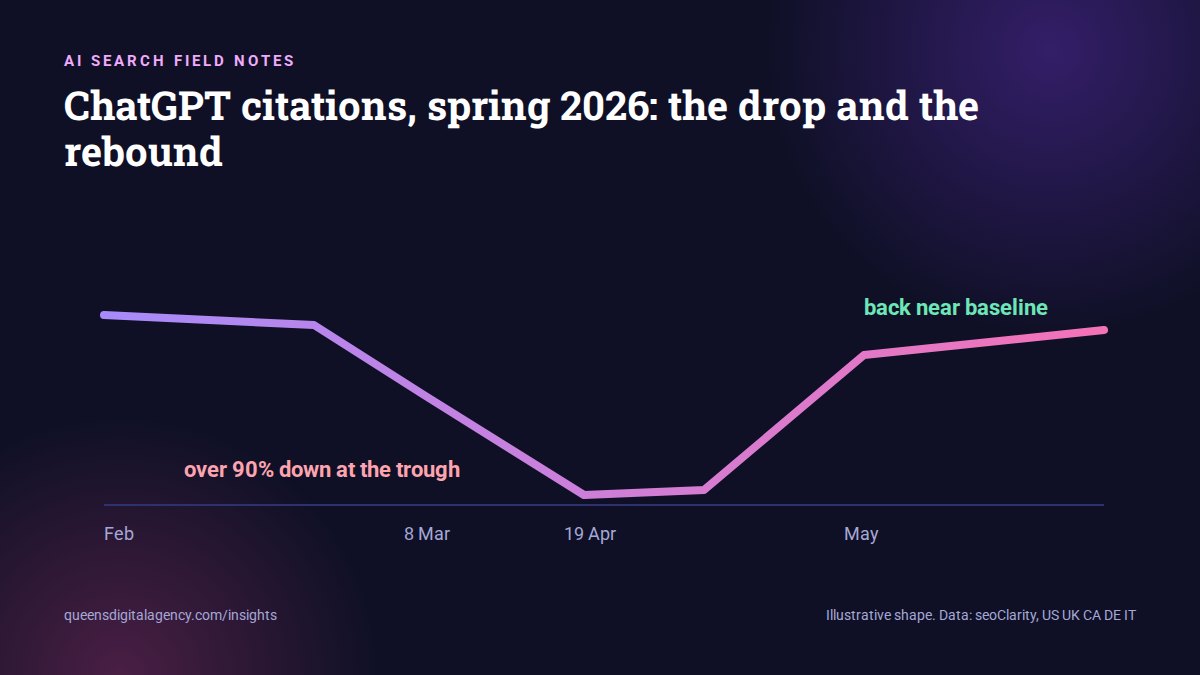
Between March and April 2026, ChatGPT citation volumes fell by over 90% at the lowest point in several markets, according to seoClarity, then rebounded toward normal levels in May. Two things happened at once: ChatGPT gave no citations for more questions, and cited fewer sources when it did. Then, on 7 May, OpenAI added clickable brand links inside answers, and AI referral traffic more than doubled in June. The lesson: AI citations are volatile and controlled by the platform, so track them over months and invest in brand authority.
Key takeaways
- ChatGPT citation volume fell over 90% at the March to April 2026 low point, then recovered in May.
- The share of US answers with zero citations jumped from 28% to 48% in March.
- From 7 May, ChatGPT added clickable brand links inside answers, and AI referral traffic rose 110% month on month in June.
- Citation swings come from the platform, not from you. Compare against competitors before reacting.
- Brand authority is the one part you control, and it survives the swings.
Imagine opening your AI visibility report and finding it had fallen by nine tenths in a few weeks.
That is roughly what many brands saw this spring. seoClarity tracked ChatGPT citations across five markets, the US, UK, Canada, Germany and Italy, from February into May 2026.
The timeline
- 8 March: the first major drop, hitting four of the five markets.
- 19 April: a deeper change. The US, UK and Germany saw citation volume fall by more than 80%.
- Late April: the low point, with citation volume in key markets down by over 90%.
- May: citations rebounded toward their pre-March levels.
Italy was the exception. seoClarity found it recovered while the other markets were still falling.
Why did citations fall so sharply?
seoClarity separated two effects, and both matter.
1. More answers with no citations at all
In the US, the share of ChatGPT answers with zero citations jumped from 28% to 48% in March. Germany’s zero-citation rate reached 85% by April, the highest of the five markets.
2. Fewer sources in the answers that did cite
By April, even when ChatGPT cited something, it cited fewer sources per answer.
Both levers moved down at the same time, which is why the fall looked so dramatic. OpenAI did not publish a detailed explanation. Platforms rarely do when they tune how answers are built.
Why does the rebound matter as much as the drop?
Because it shows who is in control.
Nothing brands did caused the drop. Nothing they did caused the recovery. Both came from changes on OpenAI’s side.
With citations dropping and rebounding on OpenAI’s timeline, they can’t be treated as a stable channel.
 Mitul Gandhi, Chief Architect and Co-Founder, seoClarity
If you had rewritten your whole content strategy in April because citations vanished, you would have been reacting to noise.
What changed again in May?
Just as citations recovered, OpenAI changed how answers link out.
Clickable brand links inside answers
On 7 May 2026, according to seoClarity, ChatGPT began adding clickable links directly on brand names inside its answers, pointing to brand websites.
The effect on traffic
- Total AI referral traffic rose 110% month on month in June, the first full month of the change.
- Traffic from ChatGPT specifically rose 130% month on month in June.
Linked brand mentions represent a fundamental change in how users interact with AI responses, shifting from zero-click answers to direct brand discovery.
seoClarity, research on ChatGPT inline citations
Notice what this rewards. Not a particular page format, but being a brand that ChatGPT names in the first place.
It is still small next to Google. Ahrefs estimated Google sends about 190 times more traffic to websites than ChatGPT. But it is growing, and it favours known brands.
Is this the same thing that happened to Reddit?
It is a similar lesson on a different scale.
In August, Reddit’s share of ChatGPT citations dropped from about 3.8% to 0.5%, as Semrush reported. Promptwatch linked it to ChatGPT sending many more searches straight to named websites.
We covered that in detail in our Reddit citations field note.
The spring drop affected almost everyone’s citations. The August drop hit one source. The May change rewarded named brands. All three came without warning.
Put together, they tell a clear story. How AI tools pick and show sources is still being tuned, often, and in public.
How should you measure AI visibility, then?
Carefully, consistently and over longer periods.
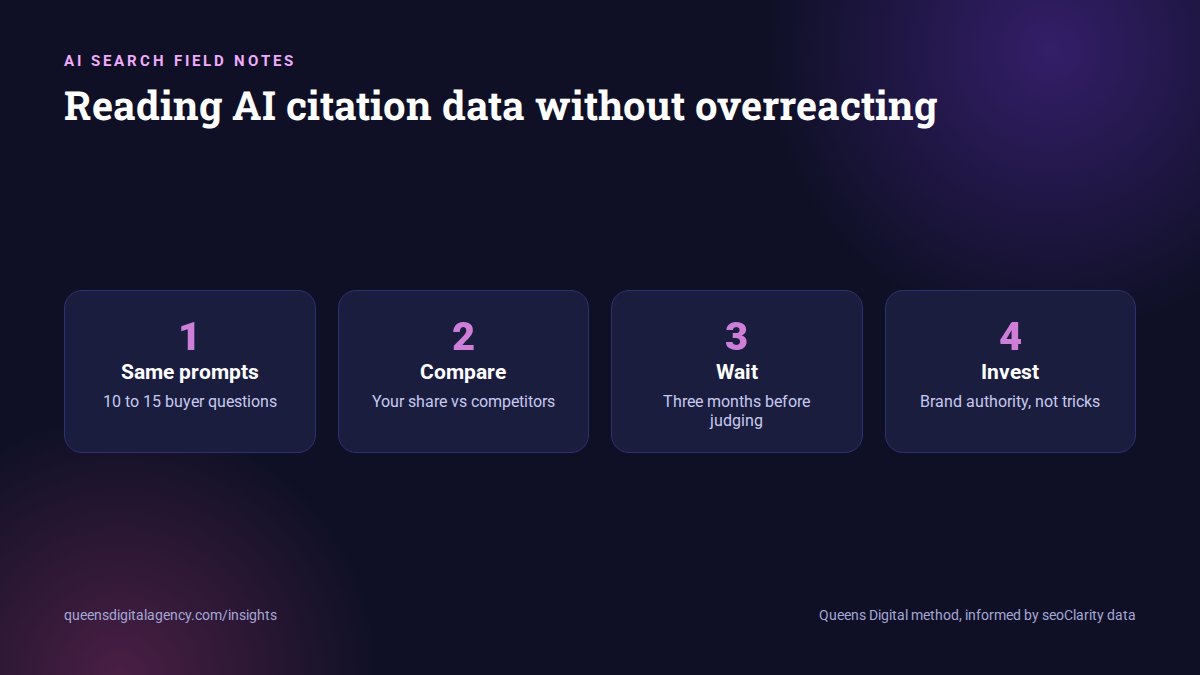
Use a fixed set of prompts
Write 10 to 15 questions your customers really ask. Use the same ones every month so the trend means something.
Compare against competitors
Track your share of mentions against two or three competitors, not only your raw count. If everyone drops together, the platform changed, not you.
Record mentions, not just links
Buyers may never click but still remember your name. With inline brand links, a mention can now also be a click.
Look across three months before changing strategy
One bad month is weather. Three bad months is climate.
Add Google’s own numbers
For Google’s AI features, add Search Console’s Generative AI performance report to the same monthly routine.
An example tracking sheet
Here is what a simple monthly sheet might look like for a study abroad consultancy in Kathmandu. The prompts are examples; use the questions your own customers ask.
- “Best education consultancy in Kathmandu for Australia”
- “Which consultancy helps with UK student visas in Nepal”
- “IELTS preparation classes in Kathmandu with good results”
- “How much does it cost to study in Canada from Nepal”
- “Is it better to apply for Australia or the UK in 2026”
For each prompt, record the month, whether you are named, which competitors are named, whether your brand is linked, and which websites are cited. After three months, the patterns are obvious: which questions you own, which a competitor owns, and which sources keep appearing that you are missing from.
If you run a consultancy, our guide to local SEO for education consultancies covers the Google Business Profile side of the same work.
What should you invest in instead of chasing citations?
Brand authority. seoClarity reached the same conclusion, and so does the wider data.
Ahrefs found branded web mentions correlated with AI Overview visibility more strongly than any other factor it tested across 75,000 brands. Its 2026 benchmark found YouTube mentions were the strongest single signal.
What that means in practice
- Clear, current answers on your own website.
- Reviews and a complete Google Business Profile, supported by local SEO.
- Mentions in news, trade and partner websites.
- Active, genuine social channels. Our social media marketing services treat these as proof, not just promotion.
- Consistent business details everywhere.
When citations dip, strong brands still get named. When they return, strong brands return first. Our AI SEO and GEO services are built around this, and you can see it in our MIT Nepal case study.
Reacting to AI citation swings: panic versus a steady approach
| Situation | Panic response | Steady response |
|---|---|---|
| Citations drop sharply | Rewrite the content strategy immediately | Check whether competitors dropped too |
| Citations recover | Credit the last change you made | Note the platform-wide pattern |
| One source disappears | Chase the next platform shortcut | Keep a spread of trusted sources |
| AI starts linking brand names | Buy mentions wherever possible | Earn genuine mentions and keep details consistent |
| Clicks from AI stay low | Decide AI does not matter | Track mentions, enquiries and branded search |
| New AI feature launches | Build a new tactic around it | Strengthen the basics it relies on |
Will this keep happening?
Almost certainly.
AI assistants are young products. Their makers are still deciding how much to cite, what to cite and how to show it. Every change ripples through visibility numbers.
Businesses that treat AI visibility like a stock price will be stressed. Businesses that treat it like reputation will be fine.
Read more: Can you pay to show up in ChatGPT? How ads and citations differ
What is the one takeaway?
Measure AI citations, but do not manage your business by them week to week.
Build the authority that survives the swings. It is the only part of this you control.
If you want help doing that, Queens Digital is a digital marketing agency in Nepal, and AI visibility tracking is part of our SEO services in Nepal.
Explore More
Citation volume in key markets fell by over 90% at the March–April trough, and then rebounded in May toward pre-March levels.
Web mentions correlate much more strongly than backlinks.

Reviewed by
K.K. Bhatta
K.K. Bhatta is a general digital marketer at Queens Digital Agency: hands-on across SEO, paid media, and whatever platform changes next. A lifelong learner rather than a one-topic specialist, he tests ideas on live campaigns before writing about them, and stays skeptical of anything that has not actually been tried.
Every claim in this article was checked against a live source before publishing.
seoClarity found citation volume in key markets fell by over 90% at the March to April 2026 low point, before rebounding toward earlier levels in May.
Two things happened together: more answers had no citations at all, and answers that did cite sources used fewer of them. OpenAI did not publish a detailed explanation.
From 7 May 2026, ChatGPT began adding clickable links on brand names inside its answers. seoClarity measured a 110% month-on-month rise in AI referral traffic in June.
Not immediately. First check whether competitors dropped too. Platform-wide changes are common, so look at trends over three months or more.
Brand authority: clear answers on your site, reviews, consistent business details and genuine mentions on trusted sites, including video.
Sources and references
Every claim above comes from the sources below, verified live before use. Accessed 25 September 2026.
- seoClarity, “Tracking the Decline of ChatGPT’s Citations: A Global Trend Analysis”
- seoClarity, “ChatGPT’s Inline Citations Surge AI Referral Traffic to Websites”
- Semrush, “Reddit’s ChatGPT citations drop from 3.8% to 0.5%”
- Promptwatch, “Why Did ChatGPT Stop Citing Reddit?”
- Ahrefs, AI Overview brand visibility factors (75,000 brands)
- Business Wire, Ahrefs Q1 2026 AI Search Benchmark Report
- Ahrefs, “ChatGPT Has 12% of Google’s Search Volume but Google Sends 190x More Traffic”